
In the Silence of the Stars, the Voice of the Creator,
On a recent holiday, I had the privilege of stepping outside under a clear sky and lifting my eyes upward. Away from the noise of the city and the heavy glow of artificial lights, the heavens opened before me in a way I had rarely seen. The sky was a canvas of brilliance, countless stars scattered across it like sparks frozen in place. A soft haze stretched across the horizon, faint yet undeniable, the Milky Way, our home galaxy, arched across the night. The air was cool, the earth quiet, and above me was a silence deeper than anything words could express. For a long while, I simply stood there, letting my eyes adjust, letting the immensity settle into me. There was beauty, yes, but also something unnerving. A reminder of how small, fleeting, and fragile we are. In those stars lay distances I could not measure, mysteries I could not grasp, a history stretching back beyond the imagination. And yet, in that immensity, in that vast silence, I felt not nothingness but presence.
Modern astronomy tells us that the universe is not static. Galaxies are hurtling away from each other, space itself is stretching like an endless fabric, and the cosmos is expanding into an unknown horizon. What we see when we look up at the sky is not just stars as they are, but stars as they were, their light travelling for thousands, even millions of years before finally reaching our eyes. In that sense, every starlit night is also a window into the past, a glimpse of history written in light. And still, for all the knowledge science has given us, there remains something hauntingly silent about it all. Space is not filled with sound but with stillness. Between those stars is a near-perfect vacuum, an emptiness so complete it defies human experience. The more we learn about the cosmos, the more overwhelming its silence seems to become. No wonder the psalmist once wrote: “When I consider your heavens, the work of your fingers, the moon and the stars, which you have set in place, what is mankind that you are mindful of them, human beings that you care for them?” (Psalm 8:3–4). Standing beneath the heavens, the psalmist felt what many of us feel even today. The tension between the immensity of the universe and the smallness of human life.
Emptiness or Presence? Some would say the silence of the universe speaks of its emptiness. To them, the night sky is indifferent, a cold expanse of matter and energy, without voice, without meaning. And yet, the biblical tradition offers another interpretation. Silence, in Scripture, is not always absence; often, it is the very medium of G-d’s presence. When Elijah fled to the wilderness and sought the voice of G-d, he did not hear it in the storm, nor in the earthquake, nor in the fire. Instead, it came in what is often translated as “a gentle whisper” (1 Kings 19:11–12). In the silence after the chaos, in the stillness beyond the noise, the prophet encountered the voice of the Eternal. So too with the cosmos. The silence of the stars is not empty but full. Full of meaning, full of awe, full of a presence that words cannot capture. The heavens may not speak in the language of sound, but they proclaim nonetheless. As Psalm 19:1 declares: “The heavens declare the glory of G-d; the skies proclaim the work of his hands.”
The Infinite and the Finite. There is another paradox at work here. On the one hand, the stars remind us of our insignificance. We are dust on a speck of dust, fleeting lives in a universe billions of years old. Our histories, our struggles, even our greatest achievements seem fragile when measured against galaxies spinning in silence. And yet, Scripture tells us that the same G-d who calls the stars by name also knows us by name. Isaiah 40:26 speaks with astonishing intimacy: “Lift up your eyes and look to the heavens: Who created all these? He who brings out the starry host one by one and calls forth each of them by name. Because of his great power and mighty strength, not one of them is missing.” If not one star is forgotten, how much more are we remembered? The Creator who commands the galaxies bends low to listen to human prayer. The One who sustains the cosmic order is mindful of the details of our lives. The heavens may make us feel small, but they also make us feel seen.
Silence as Invitation. As I stood beneath the Milky Way on that holiday night, I found myself thinking of silence in a new way. Silence is not merely the absence of sound; it is the space in which something deeper can be heard. In the silence of the stars, I began to hear a whisper of meaning, a call to humility, a summons to wonder. Perhaps that is why silence is so often associated with worship. Habakkuk 2:20 proclaims: “The Lord is in his holy temple; let all the earth keep silence before him.” The vastness of the cosmos quiets us not because it erases us, but because it points us to something greater than ourselves. In the silence, the heart begins to listen. And in listening, we find that the Creator is not absent but profoundly present. The emptiness becomes fullness, the distance becomes intimacy, the silence becomes a voice.
It is easy, in the routine of everyday life, to forget the stars. Most of us live under skies veiled by electric glow, our nights broken by the hum of traffic and the buzz of screens. Yet the stars are still there, whether we notice them or not, still proclaiming the glory of the One who set them in place.
To look at the sky is to be reminded of our place in the story of creation. We are not at the centre, yet we are not forgotten. We are small, yet beloved. The stars tell us of a universe too vast for our minds and yet crafted by hands that care even for the sparrow that falls to the ground. Jesus himself pointed to the heavens as a reminder of divine care. In Matthew 6:26, he told his disciples: “Look at the birds of the air; they do not sow or reap or store away in barns, and yet your heavenly Father feeds them. Are you not much more valuable than they?” If the birds and the stars are held in his providence, so are we.
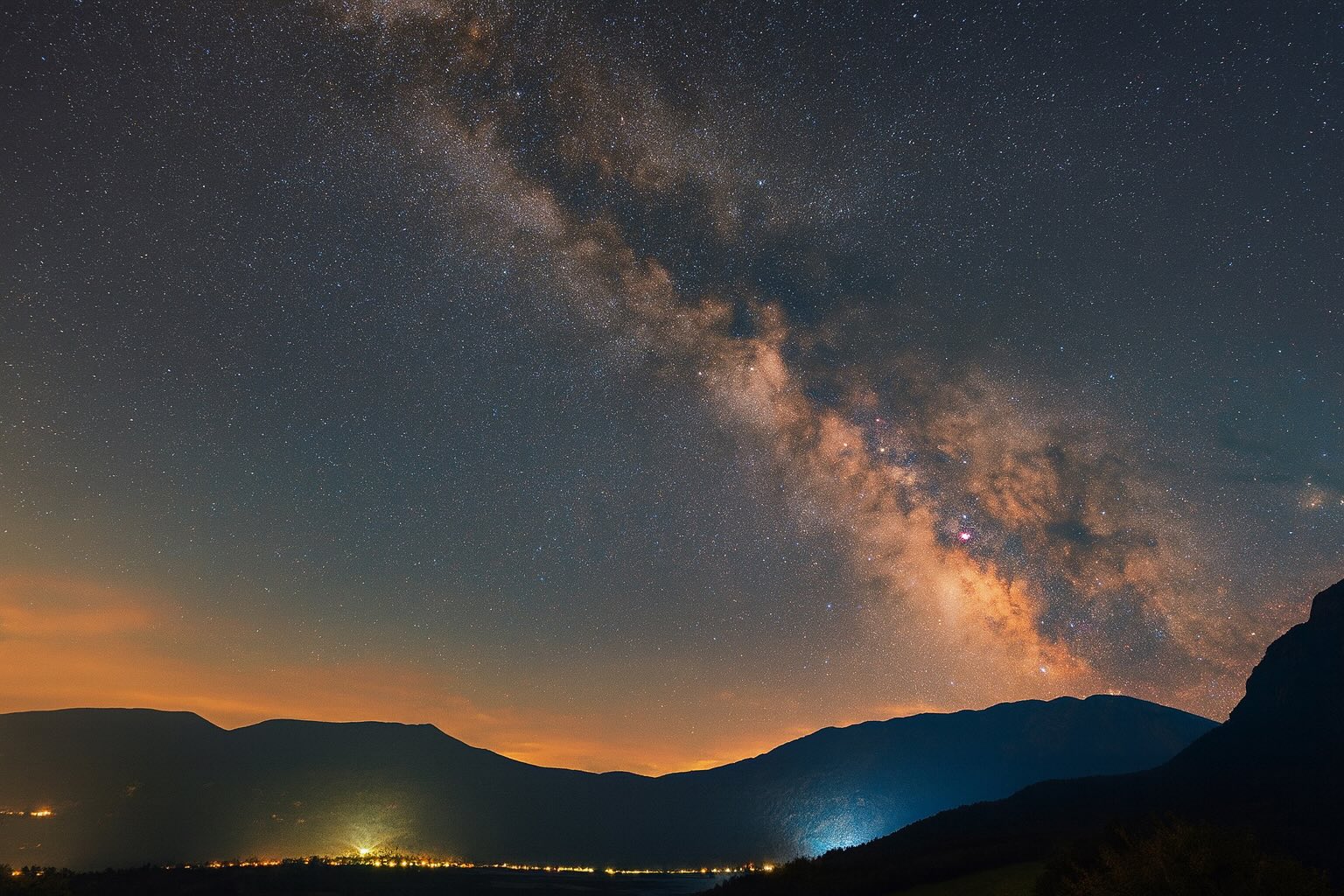
That night on holiday, I took a photograph which I share with you, a simple capture of the sky, filled with stars and the faint glow of the Milky Way. The picture is beautiful, but it is only a shadow of the reality I stood under. No lens can capture the immensity, no image the silence, no frame the presence that fills the heavens. And yet, the photograph reminds me of that moment of awe, that moment when the emptiness became presence, when the silence became voice. In the vastness of the cosmos, I found myself drawn to the One who made it, the One who speaks not through noise but through stillness, the One who holds galaxies and human hearts alike.
“Be still, and know that I am G-d.” (Psalm 46:10).
In the silence of the stars, the Creator speaks. The question is whether we will be still enough to hear.
A Sfalsin
 Raízes Hebraicas