
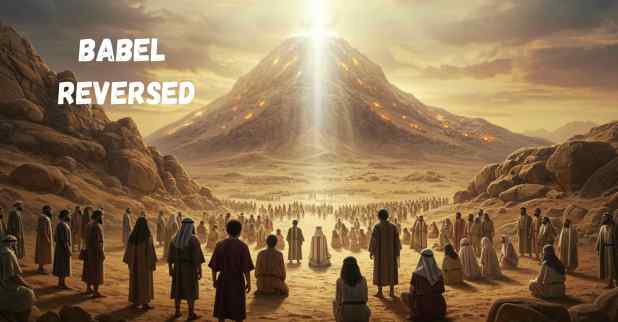
From Babel to Sinai to Jerusalem
There are moments in history that, if you squint just right and tilt your head in the direction of Heaven, you can almost see the grand Author’s hand turning a page. Babel, Sinai, and Jerusalem these are not merely locations upon a map, but punctuation marks in a divine narrative. We find ourselves, dear reader, caught in the middle of this tale.
Let us begin, as every good story does, at the beginning or nearly so.
At Babel, man conspired to construct a staircase to the stars. It was, I daresay, our first global committee. In Genesis 11:4, the ambitious proclamation is recorded: “Come, let us build ourselves a city and a tower with its top in the heavens, and let us make a name for ourselves.” Alas, pride is a poor architect. Instead of Heaven, they built confusion. Instead of glory, they earned scattering. “Therefore the name of it was called Babel, because there the Lord confused the language of all the earth.” (Genesis 11:9)
One cannot help but feel the sadness of it all. There is something inherently good about togetherness, about harmony. But at Babel, we grasped at divinity not to know G-d, but to replace Him. A unity bent inward collapses upon itself. And so the world fractured, not with war, but with syllables.
Yet G-d does not abandon. Like a master teacher who allows the child to stumble so they may learn to walk, He lets the dust settle, then begins again. Enter Abraham, a single man in a confused world, called out in Genesis 12:1–3 to be the seed of a new blessing: “In you all the families of the earth shall be blessed.”
Now, fast-forward a few centuries some six or nine, depending on whose sandglass you prefer and we arrive at Sinai. The smoke and thunder of Exodus 19 do not signify judgment alone, but intimacy. Heaven does not require towers; it descends by choice. “And the Lord came down upon Mount Sinai.” (Exodus 19:20) This is no god of marble statues or mute idols. This is a G-d who speaks.
Indeed, He speaks with such clarity that tradition says each word split into seventy tongues, the languages of all known nations. The same Voice that once divided now divides again not to confuse, but to reveal. “And G-d spoke all these words…” (Exodus 20:1) And later: “You heard the sound of words, but saw no form; there was only a voice.” (Deuteronomy 4:12) Here, the cacophony of Babel finds its counterpoint not in silence, but in singularity.
Israel, freshly redeemed from Egypt, is offered a vocation: “You shall be to Me a kingdom of priests and a holy nation.” (Exodus 19:6) They are chosen, yes, but not for themselves. A priest does not hoard light; he reflects it. Like Abraham before them, Israel was to be the conduit of divine blessing, not its reservoir.
Ah, but the story does not end in thunder and tablets.
Spin the globe and the clock forward again some 1,300 years or more and find yourself in Jerusalem. The air is thick with anticipation; the streets hum with pilgrims. It is Shavuot, the Feast of Weeks, and once again G-d chooses to speak.
“And suddenly there came from heaven a sound like a mighty rushing wind… and divided tongues as of fire appeared to them and rested on each one of them.” (Acts 2:2–3) It is Sinai again, but not quite. Fire falls not upon a mountain, but upon men. The words do not thunder from above, but pour forth from within.
And what words they are!
“We hear them telling in our own tongues the mighty works of G-d.” (Acts 2:11) Jews from all parts of the roman empire were present for the festival of shakeout, jews from Parthians, Medes, Elamites so many names, each representing a Babel once broken. The miracle of Pentecost is not the spectacle, but the synthesis. The Spirit does not erase distinction; He sanctifies it. A return to unity, not uniformity.
Peter, with the boldness of one freshly breathed upon, explains: “In the last days, G-d declares, I will pour out my Spirit on all flesh…” (Acts 2:17, quoting Joel 2:28)
And so, dear reader, we are left with three scenes:
At Babel, man ascends in arrogance and is scattered.
At Sinai, G-d descends in fire and calls a nation.
At Jerusalem, the fire descends again, now it spreads to corners of the known world.
What, then, shall we make of all this?
Firstly, let us learn that unity is not achieved by building towers, but by receiving truth. The Gospel speaks every tongue not by flattening them into one, but by filling each with the fragrance of Heaven. At Babel, our languages divided. At Pentecost, they became instruments of praise.
Secondly, chosenness is not a trophy. It is a task. Israel was chosen not to be better, but to bless. As Isaiah 49:6 reminds us: “I will make you as a light for the nations, that My salvation may reach to the end of the earth.” We the gentiles, too, shares this priestly calling: to reconcile, to bless, to serve.
Thirdly and perhaps most importantly we are caught between Pentecost and Parousia, the time between the fire and the final glory. “All this is from G-d, who through Christ reconciled us to Himself and gave us the ministry of reconciliation.” (2 Corinthians 5:18) Babel still echoes in our politics, our pride, our pulpits. But Sinai still calls. And Jerusalem still burns.
Do you long for the end of the story? I do. So did John. And he saw it:
“After this I looked, and behold, a great multitude that no one could number, from every nation, from all tribes and peoples and languages, standing before the throne…” (Revelation 7:9) The languages are still there, you notice. G-d does not undo Babel by reverting to sameness. He redeems it through harmony. And in that place, in the city not built with hands, there will be no need to make a name for ourselves. “To the one who conquers… I will give a white stone, with a new name written on it.” (Revelation 2:17) Not the name we tried to make. The one He always knew.
So here we are. The page has not yet turned. But the pen is in the Author’s hand. We are not spectators. We are characters. Better yet we are sons and daughters.
When the world divides, let us reconcile.
When it builds new Babels, let us remember the fire.
When it forgets the Voice, let us echo it.
For the Spirit did not come to make us loud. He came to make us clear.
Clarity in truth. Clarity in love. Clarity in mission.
Take heart, dear reader. The towers of man will fall, but the mountain of the Lord shall rise. And all nations shall flow to it. (Isaiah 2:2)
Adivalter Sfalsin
Read also:
 Raízes Hebraicas