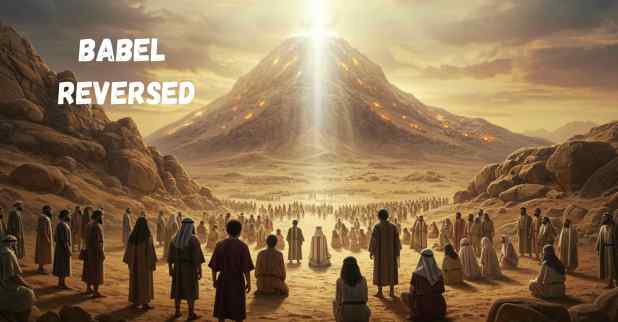
Babel reversed

Babel reversed

From Babel to Sinai to Jerusalem

There are moments in history that, if you squint just right and tilt your head in the direction of Heaven, you can almost see the grand Author’s hand turning a page. Babel, Sinai, and Jerusalem these are not merely locations upon a map, but punctuation marks in a divine narrative. We find ourselves, dear reader, caught in the middle of this tale.

Let us begin, as every good story does, at the beginning or nearly so.

At Babel, man conspired to construct a staircase to the stars. It was, I daresay, our first global committee. In Genesis 11:4, the ambitious proclamation is recorded:  “Come, let us build ourselves a city and a tower with its top in the heavens, and let us make a name for ourselves.”  Alas, pride is a poor architect. Instead of Heaven, they built confusion. Instead of glory, they earned scattering.  “Therefore the name of it was called Babel, because there the Lord confused the language of all the earth.”  (Genesis 11:9)

One cannot help but feel the sadness of it all. There is something inherently good about togetherness, about harmony. But at Babel, we grasped at divinity not to know G-d, but to replace Him. A unity bent inward collapses upon itself. And so the world fractured, not with war, but with syllables.

Yet G-d does not abandon. Like a master teacher who allows the child to stumble so they may learn to walk, He lets the dust settle, then begins again. Enter Abraham, a single man in a confused world, called out in Genesis 12:1–3 to be the seed of a new blessing:  “In you all the families of the earth shall be blessed.” 

Now, fast-forward a few centuries some six or nine, depending on whose sandglass you prefer and we arrive at Sinai. The smoke and thunder of Exodus 19 do not signify judgment alone, but intimacy. Heaven does not require towers; it descends by choice.  “And the Lord came down upon Mount Sinai.”  (Exodus 19:20) This is no god of marble statues or mute idols. This is a G-d who speaks.

Indeed, He speaks with such clarity that tradition says each word split into seventy tongues, the languages of all known nations. The same Voice that once divided now divides again not to confuse, but to reveal.  “And G-d spoke all these words…”  (Exodus 20:1) And later:  “You heard the sound of words, but saw no form; there was only a voice.”  (Deuteronomy 4:12) Here, the cacophony of Babel finds its counterpoint not in silence, but in singularity.

Israel, freshly redeemed from Egypt, is offered a vocation:  “You shall be to Me a kingdom of priests and a holy nation.”  (Exodus 19:6) They are chosen, yes, but not for themselves. A priest does not hoard light; he reflects it. Like Abraham before them, Israel was to be the conduit of divine blessing, not its reservoir.

Ah, but the story does not end in thunder and tablets.

Spin the globe and the clock forward again some 1,300 years or more and find yourself in Jerusalem. The air is thick with anticipation; the streets hum with pilgrims. It is Shavuot, the Feast of Weeks, and once again G-d chooses to speak.

 “And suddenly there came from heaven a sound like a mighty rushing wind… and divided tongues as of fire appeared to them and rested on each one of them.”  (Acts 2:2–3) It is Sinai again, but not quite. Fire falls not upon a mountain, but upon men. The words do not thunder from above, but pour forth from within.

And what words they are!

 “We hear them telling in our own tongues the mighty works of G-d.”  (Acts 2:11) Jews from all parts of the roman empire were present for the festival of shakeout, jews from Parthians, Medes, Elamites so many names, each representing a Babel once broken. The miracle of Pentecost is not the spectacle, but the synthesis. The Spirit does not erase distinction; He sanctifies it. A return to unity, not uniformity.

Peter, with the boldness of one freshly breathed upon, explains:  “In the last days, G-d declares, I will pour out my Spirit on all flesh…”  (Acts 2:17, quoting Joel 2:28)

And so, dear reader, we are left with three scenes:

At Babel, man ascends in arrogance and is scattered.

At Sinai, G-d descends in fire and calls a nation.

At Jerusalem, the fire descends again, now it spreads to corners of the known world.

What, then, shall we make of all this?

Firstly, let us learn that unity is not achieved by building towers, but by receiving truth. The Gospel speaks every tongue not by flattening them into one, but by filling each with the fragrance of Heaven. At Babel, our languages divided. At Pentecost, they became instruments of praise.

Secondly, chosenness is not a trophy. It is a task. Israel was chosen not to be better, but to bless. As Isaiah 49:6 reminds us:  “I will make you as a light for the nations, that My salvation may reach to the end of the earth.”  We the gentiles, too, shares this priestly calling: to reconcile, to bless, to serve.

Thirdly and perhaps most importantly we are caught between Pentecost and Parousia, the time between the fire and the final glory.  “All this is from G-d, who through Christ reconciled us to Himself and gave us the ministry of reconciliation.”  (2 Corinthians 5:18) Babel still echoes in our politics, our pride, our pulpits. But Sinai still calls. And Jerusalem still burns.

Do you long for the end of the story? I do. So did John. And he saw it:

 “After this I looked, and behold, a great multitude that no one could number, from every nation, from all tribes and peoples and languages, standing before the throne…”  (Revelation 7:9) The languages are still there, you notice. G-d does not undo Babel by reverting to sameness. He redeems it through harmony. And in that place, in the city not built with hands, there will be no need to make a name for ourselves.  “To the one who conquers… I will give a white stone, with a new name written on it.”  (Revelation 2:17) Not the name we tried to make. The one He always knew.

So here we are. The page has not yet turned. But the pen is in the Author’s hand. We are not spectators. We are characters. Better yet we are sons and daughters.

When the world divides, let us reconcile.

When it builds new Babels, let us remember the fire.

When it forgets the Voice, let us echo it.

For the Spirit did not come to make us loud. He came to make us clear.

Clarity in truth. Clarity in love. Clarity in mission.

Take heart, dear reader. The towers of man will fall, but the mountain of the Lord shall rise. And all nations shall flow to it. (Isaiah 2:2)

Adivalter Sfalsin

Read also:

When Heaven Touched the Earth

Day 50 Shavuot – When Heaven Touched the Earth

Two Covenants, One Mission

Day 50 – Shavuot

When Heaven Touched the Earth – Two Covenants, One Mission

The fiftieth day has arrived. After forty-nine days of introspection, purification, and spiritual growth, guided by the Counting of the Omer, we enter Shavuot, the Feast of Weeks. Yet this day is not merely the conclusion of a cycle, but its pinnacle, the summit from which the entire journey can be seen in perspective. Shavuot is not just the end of a path; it marks the beginning of a renewed mission.

On this day, we celebrate the giving of the Divine Word at Sinai and the outpouring of the Spirit in Jerusalem. The same divine summons that shaped a nation in the wilderness also ignited hearts in the Holy City. Pentecost, as it is known in Greek, is not an exclusively Christian festival, nor is it disconnected from the Hebrew Scriptures. It is, in fact, the same biblical celebration known in Hebrew as Shavuot. Two words, two languages, one single feast.

Pentecost did not begin in the New Testament. It blossomed from the deep roots of the Torah, nourished by the story of Israel’s redemption and strengthened by the promises of the prophets. Pentecost is simply Shavuot with a Greek accent.

Shavuot means “weeks”. The feast occurs fifty days after the start of the barley harvest, during the Passover season. In Leviticus 23:15–21, commands the counting of seven complete weeks, beginning the day after the Sabbath of Passover, up to the fiftieth day. This is the day of a sacred assembly, the day of the Shavuot celebration.

“And ye shall count unto you from the morrow after the sabbath, from the day that ye brought the sheaf of the wave offering; seven sabbaths shall be complete. Even unto the morrow after the seventh sabbath shall ye number fifty days.”

(Leviticus 23:15–16)

This count, known as Sefirat HaOmer, connects the physical liberation from Egypt to the spiritual revelation at Sinai. It also marks the transition from the barley harvest to the wheat harvest. Shavuot is therefore an agricultural feast, but also a covenantal one. In the biblical calendar, this is the day on which the Torah was given to the people of Israel.

Sinai was the theophany that shaped a nation. The book of Exodus recounts that fifty days after leaving Egypt, the children of Israel arrived at Mount Sinai. There, descended in fire, the mountain smoked, and the people trembled before the divine majesty. It was not a private experience. It was a collective encounter, a foundational event. spoke, and all heard — around 2.5 million people. This is unparalleled in human history. No other religion begins with the Divine manifesting before an entire nation.

“And mount Sinai was altogether on a smoke, because the Lord descended upon it in fire.”

(Exodus 19:18)

It was at Sinai that Israel received the Torah, not merely as a moral code, but as a revelation of G-d’s character and a seal of the covenant with a people chosen to be a light to the nations. Thus, Shavuot became the spiritual birthday of Israel.

In the New Testament, the Pentecost event is not a break from this sacred story, but its continuation. Centuries later, the feast of Shavuot came to be called Pentēkostē by Greek-speaking Jews of the diaspora. When we read Acts 2 and see the disciples gathered “on the day of Pentecost”, we are not witnessing a new festival, but the same biblical celebration now clothed in prophetic fulfilment.

“And when the day of Pentecost was fully come, they were all with one accord in one place.”

(Acts 2:1)

On this day, something extraordinary happens. The Holy Spirit is poured out. Tongues like fire rest upon the disciples. A sound like a mighty wind fills the room. All are filled with the Spirit and begin to proclaim the wonders of in various languages. Heaven touches earth once more.

Two fires, one message.

The parallels between Sinai and Jerusalem are striking. At Sinai, descends in fire. In Jerusalem, tongues of fire descend upon the disciples. At Sinai, the people hear G-d’s voice amid thunder. In Jerusalem, a supernatural sound fills the place. At Sinai, a priestly nation is born. In Jerusalem, the Messianic community is birthed — composed mostly of Jews who longed for the fulfilment of G-d’s promises to Israel.

Jewish tradition says that at Sinai, G-d’s voice was divided into seventy languages. This reflects the divine intention that His Word should reach all nations. In Acts 2, diaspora Jews from many parts of the Roman Empire, many of whom no longer spoke fluent Hebrew, hear the message in their native tongues. The Spirit enables the disciples to communicate eternal truth in a way that touches every heart present.

These Jews were in Jerusalem out of faithfulness to the Torah. They had not broken away from Judaism, but lived it with Messianic hope. As they witnessed the signs of the Spirit and heard the message about Yeshua, many believed. Acts 2 records that three thousand were saved that day, a striking contrast to the three thousand who perished in Exodus 32 after the golden calf incident.

These Jewish believers returned to their cities throughout the Greco-Roman world carrying a living testimony that the promised Messiah had risen. They did not take a new religion with them, but a new revelation within the same faith.

The New Covenant Promised

The prophet Jeremiah had spoken of a new covenant in which the Torah would be written upon the heart:

“I will put my law in their inward parts, and write it in their hearts.”

(Jeremiah 31:33)

Shavuot becomes the visible fulfilment of this promise. The Spirit does not cancel the Torah — He inscribes it inwardly. Paul reaffirms this when he says:

“The letter killeth, but the spirit giveth life.”

(2 Corinthians 3:6)

Yeshua and the Omer: The Precision of the Spiritual Harvest

The New Testament reveals that Yeshua rose on the Feast of First fruits — the first day of the Omer count. According to 1 Corinthians 15:20, He is “the first fruits of those who have fallen asleep”. His resurrection inaugurates the future harvest symbolised in Shavuot.

For forty days after His resurrection, Yeshua appears to the disciples, teaching about the Kingdom of G-d. In Acts 1:3 we read:

“He showed himself alive… being seen of them forty days, and speaking of the things pertaining to the kingdom of G‑d.”

After this period, He instructs them to remain in Jerusalem, awaiting the promise of the Father. They wait ten more days. On the fiftieth, during Shavuot, the Spirit is poured out.

First fruits of the Spirit and a Living Harvest

At Sinai, three thousand perished due to the sin of idolatry. In Jerusalem, three thousand are saved on the very day the Spirit is given. What was once a tragedy becomes redemption. Grace does not cancel justice, it elevates and transforms it.

Shavuot, which once marked the offering of the first agricultural fruits, now witnesses the giving of spiritual first fruits. The disciples become seeds scattered among the nations, bearers of the Kingdom.

One Mission, One Faith

Shavuot does not mark the birth of two peoples, but the unfolding of a single mission. formed Israel as a holy nation. In Jerusalem, He extends the invitation to the gentiles who believe in the Messiah. As Isaiah prophesied:

“I will also give thee for a light to the Gentiles, that thou mayest be my salvation unto the end of the earth.”

(Isaiah 49:6)

The Messianic community does not replace Israel. It is grafted into the same olive tree, as Paul teaches in Romans 11:17. The covenant continues. The mission expands.

Why Have We Forgotten This Feast?

Despite its importance, Shavuot is often overlooked in the traditional Christian calendar. Feasts with pagan roots, like Christmas, are widely celebrated. Yet the giving of the Torah and the outpouring of the Spirit, central pillars of biblical faith, are frequently neglected.

This year, Shavuot will be celebrated from sundown on Sunday, 1 June, until nightfall on Tuesday, 3 June. It is a timely moment to return to our roots, to remember the covenant, to renew our faith, and to receive a fresh breath of life.

Shavuot and Pentecost are two faces of a single revelation. The Word and the Spirit walk together. Truth and power are inseparable. The same who spoke at Sinai is the One who breathed upon the disciples in Jerusalem. Today, He still speaks, still breathes, still sends.

To celebrate Shavuot with biblical understanding is to remember that faith in Yeshua is firmly rooted in the promises made to Israel. It is to recognise that the Spirit who dwells in us is the same who descended on the mountain and set hearts ablaze in Jerusalem.

The Word was given. The Spirit was poured out. Now it is your turn.

This Shavuot, may you become a living harvest. May your life reveal the presence of with clarity, courage, and holiness.

Adivalter Sfalsin

Let’s do it again next year.

G‑d’s Clocks

G‑d’s Clocks

Understanding Time from a Biblical Perspective

Let’s start with an uncomfortable truth: you and G‑d do not share the same clock. In fact, if you think G‑d is late, it might be because you set your alarm to the wrong time zone. Biblically speaking, time is not just chronology. Time is a language. If you’ve ever wondered why divine promises seem delayed, or why some things happen at the “wrong time”, it may be because you’re trying to interpret kairos with chronos thinking or measuring olam with your digital planner. In this article, we’ll explore the biblical concepts of time in both Hebrew and Greek — not as linguistic curiosities, but as spiritual keys. Because to live wisely, hopefully, and purposefully, we must begin to understand time the way G‑d sees it.

In Hebrew: Time as Covenant, Rhythm, and Sacred Flow

  1. עֵת (‘êt) — Appointed Time – The most common Hebrew word for time, ‘êt, doesn’t refer to seconds or minutes. It speaks of meaningful moments. Of windows. Of divine cycles. It’s the kind of time that leads Solomon to say: “To everything there is a season, and a time for every purpose under heaven” (Ecclesiastes 3:1). This is not stopwatch time it’s discernment time. Knowing when to speak and when to stay silent. When to plant, when to harvest. When to wait, and when to act. Those who live by ‘êt become spiritual dancers learning to hear Heaven’s melody and move with its rhythm.
  2. 2. מוֹעֵד (mo’ed) — Sacred Time – This word is used for G‑d’s appointed feasts: Passover, Shavuot, Sukkot… times etched into the divine calendar for encounters with the Eternal. In Leviticus 23, G‑d calls these mo’adim times set by Him, not by culture or convenience. Mo’ed teaches us that time is not neutral. It can be consecrated. It can be prophetic. It can become a stage where the Creator meets His creation. To miss a mo’ed is like skipping a meeting you didn’t even know was booked in your name.
  3. 3. יוֹם (yom) — Day, Season – Literally “day”, but with a broader range. Yom can refer to a journey, a phase, or a time of divine manifestation. For instance, “the Day of the Lord” (Yom YHWH) is not 24 hours it’s a period of decisive intervention from G‑d.Understanding yom reminds us: not all days are equal. And “today” might be the acceptable day of salvation (Isaiah 49:8).
  4. 4. עוֹלָם (olam) — Eternity –  Olam is a fascinating word it implies something hidden, unreachable, like a horizon. It can mean ancient past, endless future, or G‑d’s eternal present. When Scripture says G‑d is “from everlasting to everlasting” (Psalm 90:2), the word is olam. In short, G‑d is not bound by our counting. He works outside of time, yet chooses to reveal Himself within it.

In Greek: Time as Crisis, Opportunity, and Transition

1. χρόνος (chronos) — Sequential Time – The classic clock time: days, hours, calendars. Chronos is the time in which you age, sit in traffic, pay bills. It’s the time that makes you wonder, “Why hasn’t it happened yet?” But it’s also the time where discipline is forged, faithfulness tested, and consistency cultivated. Because while you think nothing is happening, G‑d is deepening your roots. Sometimes His silence is not absence it’s hidden work. While you wait for visible answers, He’s strengthening your faith, character, and maturity. So that when the right time arrives, you not only bloom you endure. What’s invisible today supports what becomes visible tomorrow. Think of Joseph in Egypt. He spent roughly 13 years between being sold as a slave and imprisoned unjustly, with no promise fulfilled, no way out in sight. Yet, in that time, G‑d was shaping a governor — instilling humility, discernment, and preparation. When kairos arrived, Joseph was ready. Without depth, he would’ve collapsed under the pressure. But instead, he sustained an entire nation and his own family through crisis.

2. καιρός (kairos) — Opportune Time – The preacher’s favourite. Kairos is that moment when Heaven breaks in. It’s the time to act, to believe, to take your place. In Mark 1:15, Yeshua says: “The time (kairos) is fulfilled, and the Kingdom of G‑d is at hand.” Kairos is not predictable but it is discernible. It requires spiritual awareness. Those who miss their kairos may end up like the five foolish virgins with no oil (Matthew 25).

3. αἰών (aiōn) — Age, World, Eternity – Used to contrast this current age with the one to come. The present aiōn is marked by brokenness and decay. But a new aiōn is approaching where righteousness dwells. When Paul writes, “Do not be conformed to this world” (Romans 12:2), the word is aiōn. Don’t conform to the patterns of this age live as a citizen of the next.

4. ἡμέρα (hēmera) — Day – Like the Hebrew yom, hēmera can be literal or symbolic. “The Day of the Lord” in the New Testament isn’t just a date on the timeline it’s an eschatological moment. A reckoning. A revelation.

What does this change in your life? Everything. Literally everything. If you don’t see time the way G‑d does, you’ll pray in anxiety, wait in frustration, and act in haste. But once you learn to distinguish chronos from kairos, to honour the mo’adim, to perceive the days, and to live with your eyes on eternity your spiritual life steps into another dimension. You stop asking, “Why hasn’t it happened yet?” And start asking, “What is G‑d trying to teach me in this time?” You stop comparing your timeline with others, and start trusting that your kairos will come. You realise that G‑d’s “delay” is actually a perfect synchronisation between human chronos and divine kairos. And when that alignment happens, everything changes.

And if you feel out of time… Maybe you are. But only out of your time. Because in G‑d’s time, nothing is wasted. And if you’re still breathing, then kairos still lies ahead. The question is: will you keep forcing your chronos, or will you learn to dance in rhythm with kairos? Maybe it’s time to throw away the clock. Or at least, sync it with Heaven.

Adivalter Sfalsin

The Law and The Spirit

The Law and The Spirit

The Letter Kills, But the Spirit Gives Life

Unpacking the Profound Calling of the Torah in Yeshua

You’ve likely heard – or even said – the phrase, “I live by the spirit of the law, not the letter.” It sounds spiritual, modern, even liberating. But do we really understand what it means? When Paul wrote in 2 Corinthians 3:6 that “the letter kills, but the Spirit gives life”, was he rejecting the Torah? Was he calling us to abandon objective commandments in favour of a fluid and subjective spirituality? Or was he pointing us to something deeper, more demanding, and more transformative? Let us return, calmly, to the Scriptures, with open minds and sincere hearts.

First, we need to understand the terms. When Paul speaks of the “letter”, he refers to an external, mechanical obedience, carried out without the heart’s involvement, like someone fulfilling a religious protocol just to tick a box. The “spirit” of the law, on the other hand, refers to the divine intention behind the commandment – its moral, relational, educational and sanctifying purpose. This is not a case of Torah versus Spirit, but of lifeless legalism versus life-giving obedience. Paul does not abolish the Torah, he denounces the cold and soulless use of it.

This contrast is powerfully expressed in Leviticus 19, when G‑d declares, “Be holy, because I am holy” (Lev 19:2). This call was not directed only at the priests, but to all the people, who had to be present to hear it. That already tells us something. Holiness, according to the Torah, is not an exclusive spiritual category for the elite, nor a mystical label reserved for a select few. Holiness is practical and everyday. It shows itself in honesty in business, respect for parents, care for the poor, impartiality in judgement, sexual purity, and dignified treatment of foreigners. Holiness is not confined to the synagogue on Saturday or church on Sunday. It is seen in how we treat others in the queue at the shop, in traffic, or online.

And this is where the spirit of the law comes in, because G‑d does not merely desire a people who follow orders, but a people who reflect His character. The Torah was not given to train people in regulations, but to form hearts sensitive to justice, compassion and truth. That’s why Leviticus 19:18 brings one of the most powerful statements in all of Scripture, “Love your neighbour as yourself.” Yeshua, when asked about the greatest commandment, said that this one, along with loving G‑d, summarises the entire Torah and the Prophets (Matt 22:36–40). Love does not cancel the commandments, it explains them. It justifies them. It sustains them. Not stealing, not lying, not committing adultery, not oppressing – all of these are love made visible.

But the message doesn’t stop there. The medieval rabbi Nachmanides, commenting on this same chapter of Leviticus, wrote a phrase that still resounds powerfully, “It is possible to be repulsive with the permission of the Torah.” What does he mean by that? He is saying that someone may follow the most literal instructions of the Torah and still be a despicable human being. How is that possible? Because the Torah can only set boundaries for things like integrity, justice, kindness, respect, and healthy speech. It does not have the power to legislate character. That’s why commentators across centuries have worked to define what it means to be respectful, honest, and just. Even so, some people always find legal loopholes to continue being morally unacceptable.

This is not confined to the past. We still see such distortion today, even among those who call themselves followers of Yeshua. Although the apostolic writings strongly emphasise ethical teachings and the importance of a transformed character, there are still those who claim to be disciples while actively looking for ways around those expectations. The letter, when used as a shield for the ego, kills. The Spirit, when leading us to truth in love, gives life.

Jeremiah prophesied a new covenant, saying, “I will put my law in their minds and write it on their hearts” (Jer 31:33). Yeshua inaugurated that covenant, and Paul understood that it did not abolish the Torah, but internalised it. What was once engraved on stone is now written on the heart. The true disciple is not one who merely memorises verses, but one whose character has been rewritten by the hand of G‑d. This is what Paul means when he says we are “ministers of a new covenant, not of the letter, but of the Spirit.”

In the Sermon on the Mount, Yeshua shows how the spirit of the law takes practical form. He reveals that the commandment not to kill includes not harbouring hatred. That not committing adultery includes not lusting with the eyes. That the right to seek justice must give way to forgiveness and trust in G‑d. Yeshua did not lower the standard – He raised it. He did not annul the Torah – He fulfilled it, showing its deepest meaning. Living by the Spirit is harder than following the letter, because it requires your whole heart.

The letter kills because it can be used as a tool for condemnation, control, and self-promotion. It can be twisted by cold and proud hearts. But the Spirit gives life, because it is the Holy Spirit who breathes it. He transforms commandments into acts of love. He turns rules into a pathway to intimacy with the Creator. The Torah, in the hands of the Spirit, ceases to be a set of duties and becomes a map to abundant life.

Peter, in his letter, echoes Leviticus when he says, “Be holy in all you do” (1 Pet 1:15). This is not about religious isolation or spiritual perfectionism. It means being honest even when no one is watching. It means treating the delivery driver with the same honour as your spiritual leader. It means living consistently with what you profess to believe. Holiness is not limited to the temple or ritual. It blossoms in the little acts of daily life.

In an age where the world craves authenticity, the disciples of Yeshua are called to go deeper. Enough of empty debates about what is “allowed” or “forbidden”. The right question is, “Does this reflect the character of G‑d? Does this promote justice, mercy, and truth?” Living by the letter is the starting point, not the destination. We are called to more – to live by the Spirit, with hearts inclined, eyes alert, and hands ready to serve.

If this article touched something within you, wonderful. If it made you uncomfortable, perhaps even better. Sometimes, the Holy Spirit uses discomfort to remind us that the letter alone is not enough. We need Him. We need the Spirit who transforms us from the inside out, who teaches us to love as G‑d loves. So, are you ready to live beyond the letter?

 Adivalter Sfalsin

From the Unthinkable to the Norm

From the Unthinkable to the Norm

The Overton Window and the Collective Mind: How the Unthinkable Becomes Normalised

Have you ever considered how ideas that, until recently, would have been regarded as absurd are now celebrated and even demanded as standards of behaviour? How values that upheld the moral fabric of society for centuries are now mocked and excluded from public discourse? This process is no accident. It has a name, a method, and a strategy. It is known as the Overton Window. The concept was developed by Joseph P. Overton and describes the range of ideas considered acceptable within a society at any given moment. Anything within this window can be discussed and promoted publicly. What lies outside it is deemed unthinkable, taboo, or forbidden. However, this window is not fixed. It can be gradually shifted, until that which was once unacceptable becomes mandatory, and what was once the norm is branded as outdated or offensive. The Overton Window is a tool of what is often called social engineering – the use of cultural and symbolic means to shape collective thought. Unlike overt oppression, such as state censorship or direct repression, this strategy operates almost invisibly. It transforms culture from the inside out, using the language of freedom, progress, and tolerance as an instrument of moral reprogramming.

Interestingly, the Bible warned of similar mechanisms long before the modern concept emerged. In the book of the prophet Isaiah, we find a clear denunciation of value inversion in a spiritually decaying society:

“Woe unto them that call evil good, and good evil; that put darkness for light, and light for darkness.” (Isaiah 5:20)

The functioning of the Overton Window typically follows five stages. The first is to make the unthinkable merely thinkable. The absurd idea is introduced through jokes, memes, films, or satire. The goal is not to persuade, but to plant a seed. The human brain registers the idea as a possibility, even if wrapped in humour. The second stage turns the thinkable into something debatable. What was once taboo is now discussed in academia, television programmes, and on social media. The arguments are usually presented in neutral terms, with phrases like “let’s hear all sides.” Thus, initial resistance begins to wear down. In the third stage, the debatable becomes acceptable. Social pressure sets in. Those who resist the new idea are stigmatised as prejudiced, intolerant, or outdated. In the name of inclusion, silencing begins. The prophet Amos lived in a time when truthfulness was met with hostility: “They hate him that rebuketh in the gate, and they abhor him that speaketh uprightly.” (Amos 5:10) The fourth stage turns what is acceptable into the new norm. The once-marginal idea moves to the centre. It is taught in schools, promoted by legislation, and praised in the media. Dissent is suppressed, not necessarily by authoritarian government, but by societal climate itself. The so-called ‘cancel culture’ is a modern example of this dynamic. The final stage is the most dangerous: it renders the old unthinkable. Values that once upheld civilisation are ridiculed, the books that defended them are discarded, and the people who live by them are marginalised. The prophet Jeremiah lamented this hardened moral state: “Were they ashamed when they had committed abomination? Nay, they were not at all ashamed, neither could they blush.” (Jeremiah 6:15)

This pattern of cultural domination was already known in the biblical world. The book of Daniel recounts the case of young Hebrews taken to Babylon. There, they were given new names, a new education, and a new diet. The aim was to erase their identity and replace their worldview. “And the king appointed them a daily provision of the king’s meat, and of the wine which he drank: so nourishing them three years, that at the end thereof they might stand before the king.” (Daniel 1:5) This was subtle, yet total re-education.

In the book of Genesis, the same pattern of distortion is seen through dialogue: “Yea, hath God said…? Ye shall not surely die.” (Genesis 3:1–4) The enemy does not deny truth directly. He relativises it. He proposes a new interpretation. He sows doubt, until error appears acceptable.

The Bible invites us to resist such manipulation. Resistance will not come through political force or moralistic nostalgia. It must begin with personal transformation and the renewal of the mind. The apostle Paul exhorts the believers in Rome: “And be not conformed to this world: but be ye transformed by the renewing of your mind.” (Romans 12:2) We are also instructed to guard our hearts and senses against cultural contamination: “Keep thy heart with all diligence; for out of it are the issues of life.” (Proverbs 4:23) Spiritual protection is not passive. It requires vigilance, resolve, and courage. Above all, we must speak. We must denounce in love. We must teach. We must correct. Even when it costs us comfort, popularity, or acceptance. Isaiah proclaims: “Cry aloud, spare not, lift up thy voice like a trumpet, and shew my people their transgression.” (Isaiah 58:1) The complacent silence of today may become tomorrow’s ideological captivity.

Finally, the Scriptures are clear. When culture deviates from the ways of the Almighty, the people of God must separate themselves from the dominant system. In the book of Revelation, we hear a call that is both urgent and timeless:

“Come out of her, my people, that ye be not partakers of her sins.” (Revelation 18:4)

The Overton Window is a modern description of an ancient problem. A people can be completely transformed without a single shot being fired. All it takes is silent acceptance of the slow and steady shifting of truth. All it takes is surrendering to lies dressed in the language of liberty.

The apostle Peter issued a sobering warning:

“Be sober, be vigilant; because your adversary the devil, as a roaring lion, walketh about, seeking whom he may devour.” (1 Peter 5:8)

To be awake and watchful is not merely a virtue. It is a spiritual necessity.

If there is even the slightest chance to preserve truth, surely it begins with what we choose to hear, to repeat, or to remain silent about. It begins in the mind – and in what we allow to enter it. If an entire society can be transformed by what it tolerates without question, could it not also be restored by those who dare to proclaim the truth aloud?

Adivalter Sfalsin