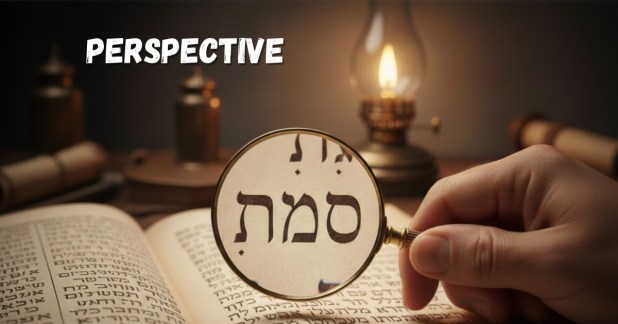
A Question of Perspective

A Question of Perspective

When we open the Bible, we often do not realise that we are entering a world that thinks in a very different way from our own. It is not merely a matter of language or ancient customs, but something deeper: a distinct way of seeing reality, the human being, and G-d Himself. Throughout the Scriptures, two great civilisations meet and, at times, come into tension. On one side stands the Greco-Roman heritage, so familiar to Western thought. On the other, the Hebrew worldview, which shapes the very language of the Bible.

The Greco-Roman tradition tends to look at the world through contemplation of form, beauty, harmony, and abstract qualities. The Greek ideal seeks to understand reality through categories, concepts, and attributes. Hebrew thought, by contrast, does not begin with ideas, but with life. It observes the world as something lived, experienced, and shaped by action. For the Hebrew mind, truth is not merely something to be defined, but something to be practised.

This difference also appears in the way each culture approaches study. For the Greeks, studying meant accumulating knowledge, organising ideas, and achieving intellectual understanding. For the Hebrews, studying was an act of reverence — a way of learning how to live before G-d. Knowledge did not have contemplation as its ultimate goal, but obedience. One learns in order to live rightly.

It is within this environment that the writers of the New Testament emerge. Although they wrote predominantly in Greek, they thought like Jews. Their mental categories were Hebrew. Their references were the Tanakh. They were not creating a new story disconnected from the previous one, but continuing the same narrative, now in the light of the revelation of the Messiah. Ignoring this is like trying to understand a musical piece by observing only its final notes, without knowing the theme that has sustained it from the beginning.

This tension between perspectives continues to influence us today, especially in the way we speak about G-d. We are often taught to describe Him through attributes. We say that G-d is omnipotent, omniscient, eternal, immutable. We also say that He is love, justice, mercy, holiness. These descriptions are not false. The problem arises when we imagine that they exhaust the way G-d reveals Himself.

Systematic theology organises these attributes with great precision, but it begins with a human question: how can we define G-d? The Bible, however, seems to begin with a different question: how does G-d act in history and in the lives of people? The difference is subtle, but decisive.

Greek thought prefers adjectives. Hebrew thought prefers verbs. The Greek asks what something is like. The Hebrew asks what something does. Imagine a sunny day. The Greek would describe it as beautiful, bright, pleasant. The Hebrew would describe it as that which warms the skin, lights the path, and makes the land produce. One looks at the quality of the sun. The other looks at the effect of the sun.

When we observe how G-d speaks about Himself in the Scriptures, this pattern becomes evident. He rarely presents Himself through abstract definitions. He presents Himself through what He has done and continues to do. “I am the Lord your G-d, who brought you out of the land of Egypt.” This is not a philosophical definition, but a historical act. “I kill and I make alive.” “I wound and I heal.” “I made the sea and the dry land.” “I am the Lord who sanctifies you.” “I stir up the sea.” “I speak.” “I protect the foreigner and sustain the orphan and the widow.”

G-d does not merely say who He is. He shows who He is through actions. Even when attributes appear, they are never detached from practice. His justice is manifested in doing justice. His mercy in caring. His holiness in separating, ordering, and restoring.

This leads us to an inevitable question: how do we relate to a G-d like this? If G-d were merely a collection of perfect attributes, our relationship with Him would be limited to distant admiration. We cannot imitate omnipotence. We cannot reproduce eternity. But if G-d reveals Himself through actions, then He invites us to imitate Him within the limits of our human condition.

This is where many people stumble over the word holiness. When they read “be holy”, they automatically understand absolute perfection — something unattainable, something that distances rather than draws near. Yet in biblical Hebrew, holiness does not begin as an adjective, but as a verb. Qadash means to separate for a purpose. Holiness is not first about what someone is, but about what someone does with their life.

Suddenly, the call changes tone. G-d is not demanding that we be flawless. He is inviting us to align our lives with His purpose — to separate ourselves from moral chaos in order to participate in the order He establishes in the world.

It is true that we cannot repeat G-d’s great cosmic acts. We cannot free an entire people from slavery, nor divide seas. But we can act as He acts within the reach of our own hands. We can do justice to the orphan and the widow. We can love the foreigner. We can give bread to the hungry and dignity to those who have been forgotten. We can live honestly, speak the truth, be faithful, reject violence, cultivate humility, and guard our tongues from evil.

This is precisely what Scripture affirms when it summarises G-d’s will in a way that is both simple and profound: to act justly, to love kindness, and to walk humbly with your G-d. What G-d does, He calls us to reflect. What He practises, He invites us to practise.

James introduces nothing new when he says that pure religion consists in caring for orphans and widows. He is merely echoing the ancient voice of the Torah. Biblical faith has never been an escape from the world, but a commitment to its restoration.

Our greatest challenge, therefore, is not learning new concepts, but unlearning certain lenses. We must resist the temptation to impose upon the Bible a worldview it does not assume. When we allow the text to speak from within its own logic, we discover that G-d does not call us to abstract perfection, but to concrete faithfulness. And when that faithfulness becomes practice, G-d ceases to be merely an object of belief and becomes recognised as a living presence acting through our actions.

Adivalter Sfalsin

Redeemed Shards

Redeemed Shards

Today I turn fifty five. Not as someone merely adding dates to a calendar, but as one who has reached a point on the road from which the journey behind can be seen with clarity and gratitude. Time does not give us all the answers, but it offers something perhaps more precious: perspective. And with it, the ability to recognise the faithfulness of D us not only in moments of celebration, but especially in ordinary, difficult and even contradictory days. Looking back, I can say with calm joy and without romanticising pain: the Lord has been my Shepherd. And even when everything seemed to be lacking, He always been there for me.

There is a persistent and mistaken idea that faith exists to shield us from life. As if trusting D us were an insurance policy against emotional fractures, irreversible loss and unanswered questions. Experience teaches exactly the opposite. Faith does not prevent us from falling. It prevents us from remaining on the ground. It does not remove the impact, but it gives something far better: resilience, meaning and a joy that does not depend on the absence of trouble.

I learned this when I received the news that radically changed the way I believed. My first daughter had been diagnosed with an irreversible condition, with no possible human solution. In that moment, it was not only the future that became uncertain. It was my theology. What I had built over decades with care, coherence and conviction proved too fragile to carry the weight of reality. Well organised doctrines, ready answers and elegant explanations shattered like a stained glass window struck by an unexpected stone.

And here the first paradox appears. It was not D us who failed. It was the simplified image of Him that I carried. When theology broke, presence remained. I discovered that D us never promised to preserve our systems intact, but He did promise to walk with us when they collapse. The joy of the Lord began precisely there. Not as excitement, but as strength. Not as constant laughter, but as daily sustenance.

For five years I lived a silence I did not choose. A silence that did not explain, did not solve, did not answer. But it did not abandon either. During that time I lost the ability to pray as I once had. Long prayers disappeared. Carefully constructed phrases became useless. All that remained was a short prayer, repeated and almost childlike: give me strength to continue. No introduction. No justification. No amen. Strangely enough, I had never prayed so little and never been so sustained.

This is another deeply liberating paradox. D us does not require sophisticated prayers in order to act. He is not moved by eloquence, but by honesty. He hears the inarticulate groan with the same attention as a beautifully crafted psalm. The joy of the Lord does not grow out of spiritual perfection, but out of real dependence.

It was in this valley that Psalm Twenty Three ceased to be decorative poetry and became an exact description of life. Even though I walk through the valley of the shadow of death. The text does not say if I enter, but when I walk. The valley is not an exception. It is part of the path. The promise is not that it will be avoided, but that it will not be crossed alone. Biblical joy is not the denial of suffering. It is the refusal to allow suffering the final word.

I thought of Joseph, sold into slavery by his own brothers at seventeen. Thirteen long years passed before he was raised at thirty as governor of Egypt. Thirteen years of betrayal, unjust imprisonment and adversity. Thirteen years without visions, without voices, without signs that anything would change. I also remembered Abraham, who waited thirteen years in divine silence between promise and fulfilment, living with the tension between what D us had spoken and what his eyes could see. These silences were not empty. They were preludes to something extraordinary. These men did not live a naive faith, but a robust one, capable of coexisting with silence without becoming cynical.

Chesterton once said that Christian joy is scandalous because it insists on existing even when everything conspires against it. It is not superficial joy, but profoundly realistic joy. It looks chaos in the face and still chooses to trust. This is not escapism. It is spiritual courage.

When my theology shattered, I noticed something surprising. The shards reflected more light than the intact window ever had. Because my trust was no longer placed in the coherence of my ideas, but in His faithfulness. The joy of the Lord began to show itself as everyday strength. Not the strength to resolve everything at once, but the strength sufficient for the next step. And then another. And then another.

The Lord is my Shepherd, I shall not be in want. This phrase, so often repeated, is frequently misunderstood. In Hebrew, the expression used is Adonai roi lo echsar. The key word is echsar, from the root chaser, meaning to be lacking, to be deficient, to be without what is essential. It is not a promise of unrestricted abundance or a life without pain. Its meaning is far deeper. I will not be in essential lack. Nothing truly necessary to fulfil the purpose of D us will be denied to me.

This changes everything. During those years, many things were missing. Answers were missing. Healing was missing. Understanding was missing. But the essential was never missing. Presence was not missing. Sustenance was not missing. Grace was not missing. The joy of the Lord as daily strength was not missing. This joy does not eliminate weariness, but it makes it bearable. It does not remove pain, but it prevents it from destroying us.

Today, at fifty five, I recognise that there is powerful testimony in the valley. Not only in achievements, but in days when everything seemed broken. It is there that we learn who D us truly is, not merely who we imagined Him to be. Sometimes He leads us to green pastures. At other times, He walks with us through the valley. At no point does He withdraw.

The true joy of walking with D us is not found in the absence of problems, but in the certainty of His presence. It is not found in never breaking, but in discovering that even shards can be redeemed. D us does not waste pain. He transforms it. He does not promise an easy life, but a meaningful one. And meaning is extraordinarily powerful. It turns weight into depth and suffering into maturity.

If you are walking through your own valley now, know this: you are not alone. It is all right not to be all right. It is all right if your prayer is short. It is all right if some days are filled with laughter and others only with endurance. The joy of the Lord is not fragile. It is firm, resilient and persistent. It refuses to be defeated by circumstances.

Today I celebrate fifty five years with genuine gratitude. Not because everything was easy, but because everything was sustained. Not because I never broke, but because I discovered that even shards can be redeemed. The Shepherd remains present. And that is enough. It has always been enough.

Divine silence is not the end of the story. It is simply the necessary pause before a deeper music.

Adivalter Sfalsin

The Same G-d: Yesterday, Today and Always

The 13 Divine Atributes

The Same G-d

Yesterday, Today and Forever

If you have ever felt that the G-d of the Old Testament and the G-d of the New Testament sound like two different characters, know that this impression is far more common than you might think. A fragmented reading of Scripture easily creates the sense that we begin with a stern and severe G-d and end with a gentle and gracious one. Yet, when the Bible is read carefully, a very different picture emerges. Above all, Scripture is a book about humanity – its failures, falls, struggles and attempts to walk with the Creator. G-d acts from Genesis to Revelation, but rarely describes Himself directly. He reveals who He is through His actions. And that is precisely why Exodus 34 is so remarkable: it is one of the few moments in which G-d explicitly declares His own character.

This revelation comes immediately after the spiritual disaster of the Golden Calf. Moses is on Mount Sinai receiving divine instruction while the people craft a glittering idol and present it as the god who brought them out of Egypt. The divine response is unsurprising: G-d declares that He will wipe out that generation. But Moses intercedes, and the impossible happens. G-d chooses to forgive, and more than that, He unveils His essential attributes.

The text reads: “The LORD, the LORD, a compassionate and gracious G-d, slow to anger and abounding in steadfast love and truth; keeping mercy for thousands, forgiving iniquity, transgression and sin, yet by no means clearing the guilty.” Here lies the heart of G-d – the same heart made visible later in the words and actions of Jesus. Jewish tradition identifies in this passage the Thirteen Attributes of Mercy, a kind of inner map of the divine character. Below they appear with the original Hebrew beside each one:

1. ADONAI, ADONAI (יהוה יהוה – merciful before and after sin)

G-d is merciful before a person sins, fully aware of our tendencies and weaknesses, and He remains merciful after the fall, offering the opportunity for return and restoration.

2. EL (אל – The Almighty One)

The absolute power who governs nature and humanity with true justice, judging each person according to the reality of their heart and their choices.

3. Rachum (רחום – compassionate)

The G-d who bends towards human suffering, especially the weak, the poor and the oppressed. He is not indifferent to human pain but acts to relieve, rescue and protect.

4. VeChanun (וְחַנּוּן – gracious)

The G-d who offers grace even to those who do not deserve it, extending comfort, help and presence to the fallen, the undeserving and the broken.

5. Erech Appayim (אֶרֶךְ אַפַּיִם – patient, slow to anger)

G-d grants time for repentance and transformation. He does not react impulsively but waits, instructs, calls and offers new opportunities.

6. Rav Chesed (רַב חֶסֶד – abundant in kindness)

G-d gives more kindness than we ask for and more than we deserve. His generosity exceeds expectations and surpasses our limitations.

7. VeEmet (וֶאֱמֶת – truthful and faithful)

G-d keeps His word and His covenant. He never promises what He will not fulfil. His faithfulness stretches across circumstances and generations.

8. Notzer Chesed Laalafim (נֹצֵר חֶסֶד לָאֲלָפִים – preserves kindness for thousands)

G-d remembers the actions of the righteous and pours blessings upon their descendants, even when these descendants are not particularly virtuous. His memory of human goodness is long and deep.

9. Nosei Avon (נֹשֵׂא עָוֹן – forgives deliberate iniquity)

Iniquity is sin committed with full intention. G-d forgives even premeditated wrongdoing when genuine repentance is present.

10. Nosei Pesha (נֹשֵׂא פֶשַׁע – forgives rebellious transgression)

Pesha is transgression carried out in conscious rebellion. Even then, G-d opens a way back when a person decides to return.

11. Nosei Chata’ah (נֹשֵׂא חַטָּאָה – forgives unintentional sin)

Chet refers to mistakes committed without intention. G-d considers human frailty, ignorance and limitation, offering forgiveness and restoration.

12. Venakeh (וְנַקֵּה – purifies)

G-d cleanses and purifies those who truly repent. He removes the stain, restores the soul and rebuilds what was broken. Yet He does not purify the one who refuses repentance, for justice and mercy walk together.

These are 12 Attributes of Mercy

Forgiveness, patience, kindness, grace.

The dominant essence of G-d’s character is merciful. He is, in His very nature, goodness, forgiveness, restoration and patience. The entire Old Testament confirms this on every page: renewed covenants, prophets sent again and again, continual invitations to return. Jesus does not introduce mercy. He embodies ancient mercy.

There is 1 Attribute of Justice

Without repentance, there can be no purification.

Divine justice does not cancel mercy, nor is it cancelled by it. G-d does not suppress human freedom. He forgives the one who accepts forgiveness. He purifies the one who desires purification. Jesus echoes this principle repeatedly when He calls people to repent. It is the same spiritual foundation, simply revealed more clearly.

And there are 3 Types of Sin Forgiven

Premeditated, rebellious and unintentional.

This triad shows the breadth of divine mercy. G-d does not forgive only accidental errors. He offers forgiveness even for intentional and rebellious sins. Peter denied Jesus knowingly and repeatedly, yet he was restored. The persecutors of the Messiah acted with collective rebellion and ignorance, yet Jesus prayed, “Father, forgive them.” The Old Testament teaches this; the New Testament displays it openly.

When we read this list attentively, the picture of G-d that emerges is not one of impatience or cruelty, but of a G-d deeply committed to mercy, kindness, patience and restoration. Justice is present, but always accompanied by grace. This is the G-d who reveals Himself at Sinai, and it is this same G-d who appears in Jesus.

Jesus does not introduce a new G-d onto the biblical stage. He reveals in human form the ancient G-d, the G-d who has always been. When He touches a leper, we see Rachum. When He forgives Peter before and after the denial, we see ADONAI repeated. When He is patient with disciples who fail to understand His teachings, we see Erech Appayim. When He multiplies food for a crowd that never even asked for it, we see Rav Chesed. When He says He came to fulfil the Torah rather than abolish it, we see VeEmet. When, on the cross, He extends forgiveness to the repentant thief, we see Nosei Avon, Nosei Pesha and Nosei Chata’ah all at work. And when He rises, making purification possible, we see Venakeh in its fullest expression.

When John says that Jesus was “full of grace and truth”, he is directly echoing Exodus 34. A first-century Jew would have recognised the parallel immediately. John is not inventing theology; he is declaring that the One who walked among them was the living embodiment of the attributes revealed to Moses. There is no contradiction between the G-d of the Old Testament and the G-d of the New. There is, instead, a perfect continuity.

This understanding challenges us to examine our own reflection. If G-d is patient, why are we so impatient? If He preserves kindness for thousands, why do we often struggle to preserve kindness for a single day? If He forgives iniquity, transgression and sin, why do we find it so difficult to tolerate even small mistakes in others? Perhaps the difficulty is not in grasping who G-d is, but in accepting that He is not like us. He is infinitely more merciful than we assume.

The Thirteen Attributes show clearly that G-d does not tire of broken human beings. He acts, forgives, restores and reveals Himself. Jesus does not create a new kind of divinity; He manifests the G-d who has always been present – the One who walked in Eden, who spoke at Sinai, who inspired the prophets and who entered human history through Jesus. The G-d of the beginning is the G-d of the end. The same yesterday, today and always.

Adivalter Sfalsin

Between Hope and Humanity

Between Hope and Humanity

A Meditation on Grief and Grace

It should have been the greatest day of celebration. The Tabernacle, Israel’s first collective house of worship, stood complete after months of painstaking labour. For seven days, Moses had performed the sacred inauguration rituals. Now the eighth day had arrived, the first of Nisan, and the priests, led by Aaron, were ready to begin their service before the Lord and all the people. Then tragedy struck with terrible swiftness.

Two of Aaron’s sons, Nadab and Abihu, brought “strange fire” before the Lord, fire “which He had not commanded them” (Leviticus 10:1). In an instant, fire came forth from the presence of G-d, and they died. The celebration became a funeral. What followed reveals something profound about faith and grief. Moses, attempting to comfort his devastated brother, said: “This is what the Lord spoke of when He said, ‘Among those who are near to Me I will show Myself holy; in the sight of all the people I will be honoured'” (Leviticus 10:3). It was as if Moses said: “Aaron, your sons were not evil, they were holy. They died not because they were far from G-d, but because they were near to Him.”

But Scripture records simply: “Aaron remained silent.” His grief was too deep for words.

Later that day, Moses discovered that Aaron had burned the sin offering rather than eating it as prescribed. Concerned for the Law and the community, Moses confronted him. Aaron’s response pierces the heart: “Today they sacrificed their sin offering and their burnt offering before the Lord, but such things as this have happened to me. Would the Lord have been pleased if I had eaten the sin offering today?” (Leviticus 10:19). In other words: “I know I am the High Priest. But I am also a father who has just lost two sons. Would G-d truly want me to act as though nothing had happened?”

When Moses heard this, Scripture tells us, “he approved” (Leviticus 10:20).

Here we witness something remarkable: Moses represents the courage to continue in faith despite tragedy; Aaron represents the courage to grieve honestly. Moses speaks of G-d’s purposes; Aaron speaks of human pain. And both, Scripture suggests, are right. Both are necessary.

There is a curious paradox at the heart of the Christian life. We are told to “rejoice always” (1 Thessalonians 5:16), yet our Saviour is described as “a man of sorrows, acquainted with grief” (Isaiah 53:3). We are commanded to “be anxious for nothing” (Philippians 4:6), yet we find ourselves weeping at gravesides, our hearts shattered by loss. Are we failing in our faith when we grieve?

C. S. Lewis, in his searing memoir “A Grief Observed”, written after the death of his wife Joy, confessed: “No one ever told me that grief felt so like fear.” Here was a man who had spent his life defending the faith with crystalline clarity, and yet in the face of death, he found himself undone. He did not lose his faith, not ultimately, but neither did he pretend that faith made him immune to the raw terror of loss. “Talk to me about the truth of religion,” he wrote, “and I’ll listen gladly. Talk to me about the duty of religion and I’ll listen submissively. But don’t come talking to me about the consolations of religion or I shall suspect that you don’t understand.”

Faith does not anaesthetise us to suffering. If anything, it makes us more alive to it, more vulnerable, more human. When Jesus stood before the tomb of Lazarus, knowing full well that He was about to raise him from death, He wept (John 11:35). He did not offer platitudes. He did not rush to the miracle. He wept with those who wept, because love demands it. There is a kind of piety, well-meaning but ultimately destructive, that treats grief as a failure of trust. The friend who quotes Romans 8:28 “…all things G-d works for the good of those who love him…” before the tears have dried. The church member who suggests that prolonged mourning indicates weak faith. These responses, however kindly intended, ask us to surrender our humanity at the altar of theology.

But consider Paul himself, who wrote those very words about all things working together for good. Was he a stranger to sorrow? He speaks of being “perplexed,” “persecuted,” “struck down” (2 Corinthians 4:8-9). He describes a “thorn in the flesh” that G-d refused to remove despite his repeated prayers (2 Corinthians 12:7-9). This is not the language of a man who has transcended pain. This is the language of someone who has learned to carry it.

The Psalms are filled with lament. “How long, O Lord? Will you forget me forever?” cries the psalmist (Psalm 13:1). “My G-d, my G-d, why have you forsaken me?” (Psalm 22:1), words Jesus Himself would echo from the cross. If lament is woven into the fabric of Scripture, then perhaps it is not the opposite of faith but rather its most honest expression. Yet grief, left alone, can become a prison. There is a second courage required of us: the courage to hope when hope seems foolish, to continue when continuing seems pointless, to believe in resurrection when all we can see is a tomb.

Here is where faith truly distinguishes itself, not in making us immune to sorrow, but in giving us a reason to rise from it. “We do not grieve as those who have no hope,” Paul writes to the Thessalonians (1 Thessalonians 4:13). Notice he does not say we do not grieve. He says we grieve “differently”. Our tears are real, but they are not the final word.

Jesus tells His disciples something almost unbearably strange: “In this world you will have trouble. But take heart! I have overcome the world” (John 16:33). He does not promise the absence of trouble. He promises its defeat. The distinction is everything. We are not asked to pretend that suffering doesn’t hurt. We are asked to believe that it doesn’t win. This is the peculiar genius of biblical hope: it is “hope in the midst”, not hope “instead of”. It does not replace our humanity with something angelic. Rather, it redeems our humanity, hallows it, makes it capable of bearing weights that would otherwise crush us. “My grace is sufficient for you,” G-d told Paul, “for my power is made perfect in weakness” (2 Corinthians 12:9). What an extraordinary claim, that G-d’s strength is most visible not in our triumph but in our fragility.

We are called to be, simultaneously, like Moses and like Aaron, to have the faith that carries on and the humanity that refuses easy comfort. This is not a contradiction to be solved but a tension to be inhabited. When Jesus prayed in Gethsemane, He showed us both. “My Father, if it is possible, may this cup be taken from me”, this is Aaron’s voice, the voice of human vulnerability, the desperate hope that perhaps suffering might be avoided. But then: “Yet not as I will, but as you will” (Matthew 26:39), this is Moses’ voice, the voice of faith that submits to a purpose larger than personal comfort.

The Christian life is not about choosing between these two voices. It is about learning to speak with both. We do not dishonour G-d by grieving deeply. We dishonour our humanity, and the G-d who made us human, when we pretend we do not feel what we feel.

“Blessed are those who mourn,” Jesus said, “for they will be comforted” (Matthew 5:4). Not “blessed are those who pretend everything is fine.” Blessed are those who mourn, who allow themselves to feel the full weight of loss, “for they” will be comforted. The comfort comes, but it comes through the grief, not around it.

Lewis, in the end, found his way through. He had learned to let his wife to go, to trust that G-d’s love for her exceeded even his own. The pain remained, but it had been, somehow, transfigured.

This is what we are offered: not escape from suffering, but transformation through it. Not the abolition of tears, but the promise that “He will wipe every tear from their eyes” (Revelation 21:4), which implies that the tears will have been real, will have been wept, will have been worth wiping away.

We live, for now, between hope and humanity, between the grief that makes us vulnerable and the faith that makes us victorious. And perhaps that is precisely where G-d intends us to be, not yet in the fullness of resurrection, but not abandoned to the darkness of the tomb either. Walking, as Paul describes it, “by faith, not by sight” (2 Corinthians 5:7), but walking nonetheless.

When adversity comes, and it will come, we need not choose between tears and trust. We can bring both to the foot of the cross, where our suffering Saviour understands them equally. We can grieve, fully and honestly, and we can hope, stubbornly and unreasonably. We can be, at once, heartbroken and unbroken.

For this is the gospel’s great claim: that our humanity need not be sacrificed to our faith, nor our faith to our humanity. In Christ, both are redeemed, both are honoured, both find their true home. And in that strange, difficult, beautiful tension, we discover what it means to be fully alive.

Adivalter Sfalsin

Dimensions of Morality

Dimensions of Morality

The Lost Dimensions of Morality

Modern morality has become a careful curator of two prized virtues, kindness and fairness. If you listen to the way people argue about right and wrong today, particularly in the secular West, it rarely strays beyond these two concerns. Will this harm someone, and is this fair? These questions are not trivial, and the moral psychologist Jonathan Haidt has shown how deeply they shape our ethical instincts. But you begin to wonder whether two virtues alone can hold the full weight of human existence. It is like trying to paint a sunrise with only two colours and telling yourself that the missing ones were unnecessary after all.

Something in us knows better. We sense that morality is richer, fuller, more textured than harm and fairness can ever express. The Bible certainly thinks so. It seems to assume that human beings are not only bodies that feel pain and not only minds that calculate fairness. We are also souls and spirits, creatures who inhabit meaning and mystery, longing and loyalty. When Scripture speaks about what is good, it speaks with a vocabulary deeper than the thin language of modern ethics.

Sometimes it becomes helpful to see the Hebrew words themselves, because they reveal dimensions of the moral life that our culture rarely names.

There is חֶסֶד (hesed, loving kindness), the active and generous goodness that goes beyond what fairness requires, found in Leviticus 19:18, Micah 6:8.

There is רַחֲמִים (rahamim, compassion or mercy), the tenderness that feels the wound of another so deeply that it becomes impossible to turn away. Psalm 103:13, Isaiah 49:15.

There is צֶדֶק (tzedek, righteousness), the conviction that the world must reflect not only what humans find convenient but what G-d calls just, as in Deuteronomy 16:20, Proverbs 21:3.

There is מִשְׁפָּט (mishpat, just judgment), the concrete application of justice in daily dealings and in the courts. Leviticus 19:15, Deuteronomy 10:18.

Then there is אֱמוּנָה (emunah, faithfulness or covenant loyalty), usually translated as faith but closer to steadiness of heart, the quality that holds relationships together, whether between people or with G-d. Deuteronomy 7:9, Habakkuk 2:4, Exodus 17:12.

And overarching them all is קְדֻשָּׁה (kedushah, holiness), the awareness that life is infused with the presence of the Creator, a truth woven through the whole of Leviticus. Leviticus 19:2, Exodus 19:6, Isaiah 6:3.

Once you see these dimensions, you realise that morality in Scripture is not trying to minimise pain or maximise fairness. It is trying to form a certain kind of person, someone whose inner life is shaped by love, compassion, justice, loyalty, and reverence. It speaks to the body, but also to the soul and to the spirit. It recognises that human beings are not flat creatures who respond only to harm and fairness but multi layered and richly dimensional beings who long for meaning, belonging, and sacred presence.

Jonathan Haidt (1) notes that pre modern and religious societies preserve these additional moral foundations. They value loyalty, respect, sanctity, compassion, and duty. They understand that communities cannot survive on kindness and fairness alone. Without loyalty, relationships fracture. 

Without reverence, life becomes trivial. 

Without holiness, the world loses its depth. 

Rabbi Jonathan Sacks once observed that when societies abandon their sense of the sacred, morality collapses into a matter of personal preference. What feels fair to me replaces what is right before G-d.

This is where the deeper biblical vision speaks to our modern confusion. Scripture presents morality through three great voices that shape the human condition. One calls us to honour what is sacred, another calls us to pursue justice, and another calls us to seek wisdom. These voices do not compete, they complete one another. They form a moral ecology that reaches every part of who we are. When we hear only one or two of those voices, our inner world begins to shrink.

C. S. Lewis often warned that modern people live as if the world had been stripped of enchantment. We analyse everything but revere nothing. We measure harm and fairness but forget gratitude, humility, loyalty, and holy awe. We fear that words like righteousness or holiness might make us look strange, so we whisper them or hide them altogether. Yet something in us refuses to be satisfied. The ache for transcendence does not disappear simply because we have replaced the language of the sacred with the language of psychology. If anything, the ache grows louder.

When we read Scripture slowly, the moral landscape begins to widen again. You notice how often the text speaks of חֶסֶד (hesed, loving kindness) as something more generous than fairness. You see how deeply it values רַחֲמִים (rahamim, compassion) that softens the heart toward the suffering of others. You observe the seriousness of צֶדֶק (tzedek, righteousness), the insistence that our choices are not morally neutral because they either affirm or violate the order G-d has woven into creation. You recognise the weight of מִשְׁפָּט (mishpat, just judgment), the practical execution of justice that protects the vulnerable. You begin to feel the steadiness of אֱמוּנָה (emunah, faithfulness), the refusal to abandon covenant commitments even when they become costly. And you learn to stand quietly before קְדֻשָּׁה (kedushah, holiness), the awareness that every moment, every life, every breath carries the imprint of G-d.

This is a far cry from the simple question, does this harm anyone. It asks instead, does this honour the sacred. Does this reflect covenant loyalty. Does this act cultivate righteousness or fracture it. Does this lead my soul toward wisdom or away from it. In other words, it treats morality not as a system of avoiding mistakes but as the slow, faithful shaping of a person who walks with G-d.

Believers in Yeshua feel this gap between biblical depth and modern thinness rather sharply. Yeshua never restricted morality to harm avoidance and fairness. His compassion was deeper than harm prevention. His justice was richer than fairness. He welcomed the outcast not because He had calculated that it was equitable but because His heart overflowed with חֶסֶד (hesed, loving kindness). He confronted hypocrisy not because it was merely unfair but because it violated צֶדֶק (tzedek, righteousness). He healed with רַחֲמִים (rahamim, compassion), taught with the wisdom of the sage, lived with the loyalty of אֱמוּנָה (emunah, faithfulness) toward the Father, and moved in a constant awareness of קְדֻשָּׁה (kedushah, holiness).

To imitate Him is to rediscover the fullness of the moral life. It is to recognise that the spirit within us must be shaped as much as the body and soul. It is to remember that morality asks not only how to prevent harm but how to become holy. Not only how to be fair but how to be faithful. Not only how to avoid cruelty but how to cultivate compassion. Not only how to balance rights but how to honour sacred obligations. This is a far more demanding vision than the modern one, and also far more beautiful.

If modern ethics feels small, it is because it has lost its tallest pillars. It has forgotten קְדֻשָּׁה (kedushah, holiness) and אֱמוּנָה (emunah, faithfulness), and in their absence the structure shivers. But Scripture has not forgotten them, nor have the sages of Israel, nor have the disciples of Yeshua (Jesus) who continue to listen for those deeper voices. When we open ourselves to this wider moral vocabulary, something within us expands. We remember who we are, creatures fashioned in the image of G-d, called not merely to avoid harm but to reflect holiness.

Perhaps this is the task for believers today, not to rage against modern morality but to gently expand it, to reintroduce our world to the richer music of חֶסֶד (hesed, loving kindness), רַחֲמִים (rahamim, compassion), צֶדֶק (tzedek, righteousness), מִשְׁפָּט (mishpat, just judgment), אֱמוּנָה (emunah, faithfulness), and קְדֻשָּׁה (kedushah, holiness). If we allow these words to shape us, body, soul, and spirit, we may find that the flattened moral world begins to rise into something three dimensional again, something spacious and alive. And perhaps we will discover that this ancient moral architecture still stands quietly behind us, waiting for us to walk back in, not as strangers but as children returning home.

Adivalter Sfalsin

(1) Jonathan Haidt, The Righteous Mind: Why Good People Are Divided by Politics and Religion (London, Allen Lane, 2012).

Doing What Is Right and Just

Doing What Is Right and Just

Among the most ancient words of the Torah, there is a phrase that still echoes today as a moral compass for humanity. It was spoken to Abraham, the first to hear the voice of a G-d who did not demand temples, but conduct. A G-d who desired not merely worshippers, but men and women capable of uniting faith with justice, love with truth, compassion with responsibility.

There are words in Scripture that do more than instruct; they shape entire civilisations. Among them, few possess such moral power as those the Eternal spoke concerning Abraham:

“For I have chosen him, that he may command his children and his household after him to keep the way of the Lord, by doing what is right and just, so that the Lord may bring upon Abraham what He has spoken of him.”

(Genesis 18:19)

In this modest verse, the Creator reveals the heart of the covenant. Abraham was not called merely to be the father of a people or of many nations, but to be the founder of a vision. His mission was to build a path, a way of life in which the name of G-d would be honoured not only in words, but in deeds.

In Hebrew, the words used by G-d contain entire universes of meaning. Tzedakah (צְדָקָה) derives from tzedek, meaning righteousness, goodness, generosity, moral integrity. It is the desire to do good, not out of obligation, but out of love. It is to give, to forgive, to restore, to care, the divine heartbeat pulsing within human action. It is often inadequately translated in the New Testament as charity.

Mishpat (מִשְׁפָּט) comes from shafat, meaning to judge, to balance, to decide with equity. It represents order, truth, and discernment, the foundation that sustains justice among people. It is the sense of right and wrong, of responsibility and consequence.

Perfect justice is born when tzedakah and mishpat walk together, when law meets mercy and compassion is anchored in truth. A world that has only mishpat becomes cold and harsh; a world that has only tzedakah loses itself in emotion without direction. The balance between the two reflects the very face of G-d.

Abraham was chosen to teach this harmony. In a culture that sought to appease gods through blood and sacrifice, he was called to reveal a G-d who delights more in justice than in offerings, more in mercy than in power, more in truth than in appearance. Holiness, in its purest form, does not dwell in temples but in the conscience. The altar the Eternal desired was not made of stone, but of heart.

Yet even before hearing the divine voice, Abraham had already learned the language of justice. While the generation of the Tower of Babel sought to build a name for themselves, Abraham sought to preserve the name of his brother who had died. He married Sarah, the daughter of Haran, not out of ambition but out of compassion. His first tzedakah was a family act, silent, hidden among the sorrows of a grieving home. And perhaps that is why the Eternal chose him. For the one who guards another’s memory becomes a living memory of G-d’s own presence.

In Abraham, the calling began at home. The Eternal chose him so that he might teach his children and his household after him to keep the way of the Lord by doing what is right and just. The movement is intimate, inward, familiar. Justice begins in the home, love blossoms in the tent, righteousness is learned among the children. From within arises the example that transforms what is around. The covenant with Abraham marks the birth of personal ethics, the man who learns to be just before trying to change the world.

But in David, the direction is reversed. “David reigned over all Israel, doing what was just and right for all his people.” (2 Samuel 8:15) Here the words are inverted, mishpat u’tzedakah, justice first, then mercy. The king begins with the social order, with law and governance. He rules, legislates, establishes mishpat, the rule of law, and only then allows tzedakah, compassion, to permeate the structures of the kingdom.

Why this inversion? Because Abraham speaks to the conscience, while David speaks to the crown. The first is the man of the tent; the second, the man of the throne. One is called to transform the family; the other, to reform the nation. Abraham represents the individual who radiates justice from within outward; David represents the ruler who brings justice from above downward.

In Abraham, faith shapes the home and, through it, the world. In David, leadership shapes society and, through it, the hearts of people. In the father of faith, the movement is personal and formative, building character. In the anointed king, the movement is institutional and public, building order. In Abraham, tzedakah precedes mishpat, for true justice is born of inner compassion. In David, mishpat precedes tzedakah, for true compassion needs order in which to flourish.

The first is the man who sows justice in the field of the heart. The second is the king who organises justice in the field of the nation. The first teaches his household; the second governs his people. And both reveal one divine truth: justice begins in the individual, but must reach the community; power is born of compassion, but is sustained only by equity.

And so, which path must we rediscover today? Abraham’s, awakening the conscience from within? Or David’s, reforming the world from above? Perhaps the challenge is to unite the two, to be people who build justice inwardly and extend it outward, leaders, even unseen ones, who transform structures through small and faithful acts.

The prophets understood this tension and turned it into a cry. Amos lifted his voice against religion without ethics and called for justice to roll like waters. Isaiah proclaimed that Zion would be redeemed not by ritual, but by righteousness. Jeremiah, with the tenderness of one who knows the heart of G-d, declared that there is no glory in being wise, strong, or rich, but only in knowing the Lord, who exercises kindness, justice, and righteousness on the earth, for in these He delights.

To know G-d is to imitate Him. And to imitate Him is to do good. True faith is not emotion or doctrine, but conduct. It is the union between altar and marketplace, between heart and tribunal, between prayer and action.

In the Gospels, Yeshua continued this same legacy. He criticised those who tithed meticulously yet neglected the weightier matters of the Torah, justice, mercy, and faithfulness. He did not abolish the Torah; He revealed its spirit. Justice without love is death. Love without truth is illusion. Faith without ethics is vanity. The way of the Lord is always the meeting of discipline that corrects and grace that restores.

And we, who live in a world where law becomes impersonal and love grows frail, what have we done with this calling? We speak of rights, yet forget duties. We seek compassion, yet fear truth. We long for freedom, yet flee responsibility. Still, the call of Abraham remains alive. What G-d expected of him, He still expects of us: to teach our children, to care for our homes, to walk in righteousness.

To do what is right and just is not a utopia; it is an act of spiritual resistance. It is to choose good when the world prefers convenience, to keep one’s word when silence would be easier, to share bread when instinct says to hoard, to defend the weak when the crowd turns away.

The world changes through small gestures. Each time someone chooses truth over lies, justice over vengeance, compassion over indifference, the legacy of Abraham is renewed. Every act of tzedakah is a seed of light; every gesture of mishpat is a stone in the rebuilding of humanity.

To keep the way of the Lord is to live with a heart aligned to His character. It is not to separate faith from conduct, prayer from responsibility, spirituality from humanity. The Creator does not seek perfection, but coherence. He does not demand purity without purpose, but faithfulness amidst imperfection.

Human history is a cycle of vengeance and power, yet the divine dream is to break that cycle with a river of justice. G-d does not desire a merely religious world, but one redeemed by the ethics of His Kingdom. The justice of G-d is not the sword that destroys, but the hand that corrects and heals. Righteousness is not the absence of error, but the presence of goodness.

And perhaps this is the final question that Genesis leaves us: will we be a generation that speaks of faith, or one that lives justice?

Every time truth and mercy meet, something of the Kingdom manifests among us. Every time a man or woman chooses what is right and just, Abraham once more becomes the father of many nations, and the dream of G-d breathes again among the children of promise. To do what is right and just is more than obeying a commandment; it is to share in the very breath of the Creator, to allow heaven to find a home on earth, to live so that, in looking at us, the world may perceive a reflection of the Lord.

Adivalter Sfalsin

Between Destiny and Chance Hearing the Call of the Small Aleph When the Book of Leviticus opens, it does so with a single word that could easily go unnoticed: Vayikra וַיִּקְרָא – “He called.” Hardly the sort of word that makes fireworks explode in the reader’s imagination. Yet hidden in that one Hebrew verb is an entire theology of history, identity, and destiny. Open a Torah scroll and you’ll see that the last letter of Vayikra – the aleph (א) – is written unusually small. That miniature letter, dangling at the edge of the parchment, has puzzled and fascinated readers for centuries. Why did the scribes shrink it? Did someone’s quill slip? The rabbis assure us it was intentional. They tell us that Moses, out of humility, wanted to write Vayikar וַיִּקָּר – “He happened upon.” He felt too unworthy to claim that G-d had “called” him personally. G-d insisted otherwise. The compromise was a small aleph, humility written into revelation. And that, dear reader, is where the entire spiritual adventure begins. In Hebrew, the difference between Vayikra וַיִּקְרָא (“He called”) and Vayikar וַיִּקָּר (“He happened upon”) is one tiny letter, yet it separates meaning from accident, destiny from chance. To Moses, G-d calls; to Balaam, the mercenary prophet, G-d merely appears. One lives by vocation, the other by coincidence. In English we have a related word: vocation, from the Latin vocare, “to call.” Before it was hijacked by career counsellors and job boards, it meant precisely what Leviticus means – a divine summons to partnership. Life is not random existence; it is response. The modern world, of course, finds this embarrassing. We prefer careers to callings and options to obedience. We build apps to choose our lunch, then wonder why we cannot choose our purpose. Yet the Bible dares to whisper that history itself is not a collision of atoms but a conversation between G-d and humanity. Every “coincidence” might in fact be an invitation. The small aleph of Vayikra is more than calligraphic curiosity; it is theology in miniature. It teaches that divine encounter does not inflate the ego, it humbles it. The voice that called Moses out of the Tent of Meeting was not a thunderclap but, as Elijah later learned, a still small voice. C. S. Lewis once joked that humility is not thinking less of yourself but thinking of yourself less. The Torah got there first. The small aleph is that very posture – the lowering of self so that the whisper of G-d can be heard. And if we’re honest, that whisper is often drowned by noise: our plans, our anxieties, our self-promotion. We long for G-d to shout, but He seems committed to gentle speech. Apparently, heaven prefers to be heard rather than forced upon us. Long before Moses and the Tabernacle, another man heard a call: “Go from your country… to the land I will show you.” That “Go” (Lech-Lecha) is the seed of Vayikra. Abraham didn’t find G-d; G-d found him, and history bent around that encounter. Through Abraham, a people was called not for privilege but for purpose: to bless all families of the earth. Their survival through exiles, empires, and inquisitions defies every statistical chart. Chance would have erased them; destiny preserved them. And here is where we gentiles stumble upon our own small aleph. Paul says we have been grafted into that same olive tree, not as replacements but as participants in the same calling. The story of Israel is not someone else’s history; it is the backbone of ours. To speak of Vayikra is therefore to speak of a shared vocation, Jew and gentile alike summoned to reflect the character of the King whose kingdom Yeshua described when He taught us to pray, “Your will be done on earth as it is in heaven.” The call has always been global, the aleph always small. If you view history through the lens of Vayikar – “it just happened” – then Israel’s existence is a fluke, and your own faith a neurological accident. But if you read history through Vayikra, you begin to see a pattern of divine handwriting, patient and persistent. Leviticus itself begins with Vayikra and ends with the word keri קֶרִי, meaning “happenstance,” “accident,” or “indifference.” The word appears several times in Leviticus 26, describing a people who walk “with Me in keri,” that is, treating G-d’s providence as coincidence. It is the very opposite of covenantal awareness. The book, therefore, is framed by the tension between Vayikra and keri, destiny and chance. So is your life. From one angle, the Cross looked like the ultimate accident – a failed messiah executed by empire. From another, it was the centre of redemption, the hinge on which eternity turned. The same event, two readings. What separates them is faith’s capacity to hear purpose in pain. Rabbi Jonathan Sacks, in Leviticus: The Book of Holiness (pp. 57–60), observed that Israel’s holiness had two faces: the priestly and the prophetic. The priest sanctifies time through rhythm and ritual; the prophet sanctifies history through justice and mercy. Leviticus, the priestly book, exists to remind us that sacred order matters. But it is framed by stories of history – Exodus before it, Numbers after it – as if Scripture were saying, “Worship must spill into the world.” Ritual without righteousness becomes theatre; activism without reverence becomes noise. Both have their purpose, and both are needed. The same holds for the followers of Yeshua. We live in sacred time through prayer and communion, yet we walk through sacred history in our boardrooms, classrooms, and bus stops – places where the kingdom can be embodied. When worship and witness embrace, we hear again the echo of Vayikra. Now comes the uncomfortable part. If the aleph is small, then listening must be large. Our age is addicted to volume: the louder the opinion, the truer it must be. Silence, on the other hand, feels like failure. But G-d still prefers whispers. He meets Mary Magdalene in a garden with a single word, “Mary.” He walks unrecognised with two disciples until the breaking of bread. He breathes peace rather than delivering a sermon. Every scene of resurrection is quiet, as if the Creator were allergic to spectacle. Maybe holiness still enters the world that way: through unnoticed acts of obedience, through prayers nobody tweets, through faithfulness that never makes the news. The kingdom of heaven does not trend; it grows. To live Vayikra is to believe that no moment is meaningless, that washing dishes, writing essays, or comforting a friend can all become expressions of G-d if done in response to the call. And so the question returns: are you called, or are you coincidental? If life is Vayikar (וַיִּקָּר), everything is chance. Morality dissolves into subjectivity, and the line between right and wrong becomes a matter of personal opinion. Suffering loses its meaning, becoming merely a detour in a universe without direction. The world turns into noise — disconnected sounds of human wills colliding, without melody or conductor. Existence becomes a fragmented narrative, written by no one and destined to be forgotten. But if life is Vayikra (וַיִּקְרָא), everything gains direction. Morality ceases to be a personal choice and begins to reflect the moral order of the Creator Himself. Suffering ceases to be punishment or absurdity and becomes a path toward purpose. Life ceases to be noise and becomes symphony — every note, even the dissonant ones, part of a greater harmony that only the Divine Maestro can fully comprehend. To live Vayikar is to drift with the tide of chance; to live Vayikra is to respond to the call. One lives by impulse, the other by purpose. One seeks momentary pleasure, the other eternal meaning. Sacks concluded that the first word of Leviticus defines the destiny of Israel – “a kingdom of priests and a holy nation.” But the same sentence defines us all. To follow Yeshua is to hear that priestly call extended to the nations: not to replace Israel but to join the symphony of holiness that began with Abraham. To live by Vayikra is to stand where eternity meets Tuesday morning, to let heaven’s grammar shape your schedule. Every act of faith is a small aleph written into the world – humble, easily missed, yet indispensable to the sentence of redemption. History, then, is not accidental but a manuscript of divine patience. Each life is a line in that story, each prayer a syllable, each act of kindness a comma in the sentence of G-d’s mercy. So we return to the same question Moses faced, pen trembling above the parchment: Will you write Vayikra וַיִּקְרָא or Vayikar וַיִּקָּר over your life? Will you live as someone called, or as someone who merely happened? The small aleph waits, quiet, stubborn, holy, for your answer. Adivalter Sfalsin Footnotes 1. Leviticus 1:1 – “And He called (וַיִּקְרָא) to Moses, and the LORD spoke to him from the Tent of Meeting, saying…” 2. Numbers 23:4, 16 – “And God happened upon (וַיִּקָּר) Balaam, and he said to Him, ‘I have prepared the seven altars…’” 3. Leviticus 26:21, 23–24, 27–28 – “If you walk with Me with keri (קֶרִי), I also will walk with you with keri,” meaning indifference or happenstance; G-d responds measure for measure to those who treat His providence as coincidence. 4. Exodus 19:6 – Israel’s vocation described as “a kingdom of priests and a holy nation.” 5. Romans 11:17–18 – Paul’s image of gentiles grafted into Israel’s olive tree.

Between Destiny and Chance

Hearing the Call of the Small Aleph

When the Book of Leviticus opens, it does so with a single word that could easily go unnoticed: Vayikra וַיִּקְרָא – “He called.” Hardly the sort of word that makes fireworks explode in the reader’s imagination. Yet hidden in that one Hebrew verb is an entire theology of history, identity, and destiny.

Open a Torah scroll and you’ll see that the last letter of Vayikra – the aleph (א) – is written unusually small. That miniature letter, dangling at the edge of the parchment, has puzzled and fascinated readers for centuries. Why did the scribes shrink it? Did someone’s quill slip? The rabbis assure us it was intentional. They tell us that Moses, out of humility, wanted to write Vayikar וַיִּקָּר – “He happened upon.” He felt too unworthy to claim that G-d had “called” him personally. G-d insisted otherwise. The compromise was a small aleph, humility written into revelation. And that, dear reader, is where the entire spiritual adventure begins.

In Hebrew, the difference between Vayikra וַיִּקְרָא (“He called”) and Vayikar וַיִּקָּר (“He happened upon”) is one tiny letter, yet it separates meaning from accident, destiny from chance. To Moses, G-d calls; to Balaam, the mercenary prophet, G-d merely appears. One lives by vocation, the other by coincidence. In English we have a related word: vocation, from the Latin vocare, “to call.” Before it was hijacked by career counsellors and job boards, it meant precisely what Leviticus means – a divine summons to partnership. Life is not random existence; it is response. The modern world, of course, finds this embarrassing. We prefer careers to callings and options to obedience. We build apps to choose our lunch, then wonder why we cannot choose our purpose. Yet the Bible dares to whisper that history itself is not a collision of atoms but a conversation between G-d and humanity. Every “coincidence” might in fact be an invitation.

The small aleph of Vayikra is more than calligraphic curiosity; it is theology in miniature. It teaches that divine encounter does not inflate the ego, it humbles it. The voice that called Moses out of the Tent of Meeting was not a thunderclap but, as Elijah later learned, a still small voice. C. S. Lewis once joked that humility is not thinking less of yourself but thinking of yourself less. The Torah got there first. The small aleph is that very posture – the lowering of self so that the whisper of G-d can be heard. And if we’re honest, that whisper is often drowned by noise: our plans, our anxieties, our self-promotion. We long for G-d to shout, but He seems committed to gentle speech. Apparently, heaven prefers to be heard rather than forced upon us.

Long before Moses and the Tabernacle, another man heard a call: “Go from your country… to the land I will show you.” That “Go” (Lech-Lecha) is the seed of Vayikra. Abraham didn’t find G-d; G-d found him, and history bent around that encounter. Through Abraham, a people was called not for privilege but for purpose: to bless all families of the earth. Their survival through exiles, empires, and inquisitions defies every statistical chart. Chance would have erased them; destiny preserved them. And here is where we gentiles stumble upon our own small aleph. Paul says we have been grafted into that same olive tree, not as replacements but as participants in the same calling. The story of Israel is not someone else’s history; it is the backbone of ours. To speak of Vayikra is therefore to speak of a shared vocation, Jew and gentile alike summoned to reflect the character of the King whose kingdom Yeshua described when He taught us to pray, “Your will be done on earth as it is in heaven.” The call has always been global, the aleph always small.

If you view history through the lens of Vayikar – “it just happened” – then Israel’s existence is a fluke, and your own faith a neurological accident. But if you read history through Vayikra, you begin to see a pattern of divine handwriting, patient and persistent. Leviticus itself begins with Vayikra and ends with the word keri קֶרִי, meaning “happenstance,” “accident,” or “indifference.” The word appears several times in Leviticus 26, describing a people who walk “with Me in keri,” that is, treating G-d’s providence as coincidence. It is the very opposite of covenantal awareness.

The book, therefore, is framed by the tension between Vayikra and keri, destiny and chance. So is your life. From one angle, the Cross looked like the ultimate accident – a failed messiah executed by empire. From another, it was the centre of redemption, the hinge on which eternity turned. The same event, two readings. What separates them is faith’s capacity to hear purpose in pain.

Rabbi Jonathan Sacks, in Leviticus: The Book of Holiness (pp. 57–60), observed that Israel’s holiness had two faces: the priestly and the prophetic. The priest sanctifies time through rhythm and ritual; the prophet sanctifies history through justice and mercy. Leviticus, the priestly book, exists to remind us that sacred order matters. But it is framed by stories of history – Exodus before it, Numbers after it – as if Scripture were saying, “Worship must spill into the world.” Ritual without righteousness becomes theatre; activism without reverence becomes noise. Both have their purpose, and both are needed. The same holds for the followers of Yeshua. We live in sacred time through prayer and communion, yet we walk through sacred history in our boardrooms, classrooms, and bus stops – places where the kingdom can be embodied. When worship and witness embrace, we hear again the echo of Vayikra.

Now comes the uncomfortable part. If the aleph is small, then listening must be large. Our age is addicted to volume: the louder the opinion, the truer it must be. Silence, on the other hand, feels like failure. But G-d still prefers whispers. He meets Mary Magdalene in a garden with a single word, “Mary.” He walks unrecognised with two disciples until the breaking of bread. He breathes peace rather than delivering a sermon. Every scene of resurrection is quiet, as if the Creator were allergic to spectacle. Maybe holiness still enters the world that way: through unnoticed acts of obedience, through prayers nobody tweets, through faithfulness that never makes the news. The kingdom of heaven does not trend; it grows. To live Vayikra is to believe that no moment is meaningless, that washing dishes, writing essays, or comforting a friend can all become expressions of G-d if done in response to the call.

And so the question returns: are you called, or are you coincidental? If life is Vayikar (וַיִּקָּר), everything is chance. Morality dissolves into subjectivity, and the line between right and wrong becomes a matter of personal opinion. Suffering loses its meaning, becoming merely a detour in a universe without direction. The world turns into noise — disconnected sounds of human wills colliding, without melody or conductor. Existence becomes a fragmented narrative, written by no one and destined to be forgotten. But if life is Vayikra (וַיִּקְרָא), everything gains direction. Morality ceases to be a personal choice and begins to reflect the moral order of the Creator Himself. Suffering ceases to be punishment or absurdity and becomes a path toward purpose. Life ceases to be noise and becomes symphony — every note, even the dissonant ones, part of a greater harmony that only the Divine Maestro can fully comprehend. To live Vayikar is to drift with the tide of chance; to live Vayikra is to respond to the call. One lives by impulse, the other by purpose. One seeks momentary pleasure, the other eternal meaning.

Sacks concluded that the first word of Leviticus defines the destiny of Israel – “a kingdom of priests and a holy nation.” But the same sentence defines us all. To follow Yeshua is to hear that priestly call extended to the nations: not to replace Israel but to join the symphony of holiness that began with Abraham. To live by Vayikra is to stand where eternity meets Tuesday morning, to let heaven’s grammar shape your schedule. Every act of faith is a small aleph written into the world – humble, easily missed, yet indispensable to the sentence of redemption. History, then, is not accidental but a manuscript of divine patience. Each life is a line in that story, each prayer a syllable, each act of kindness a comma in the sentence of G-d’s mercy. So we return to the same question Moses faced, pen trembling above the parchment:

Will you write Vayikra וַיִּקְרָא or Vayikar וַיִּקָּר over your life?

Will you live as someone called, or as someone who merely happened? The small aleph waits, quiet, stubborn, holy, for your answer.

Adivalter Sfalsin

Footnotes

1. Leviticus 1:1 – “And He called (וַיִּקְרָא) to Moses, and the LORD spoke to him from the Tent of Meeting, saying…”

2. Numbers 23:4, 16 – “And God happened upon (וַיִּקָּר) Balaam, and he said to Him, ‘I have prepared the seven altars…’”

3. Leviticus 26:21, 23–24, 27–28 – “If you walk with Me with keri (קֶרִי), I also will walk with you with keri,” meaning indifference or happenstance; G-d responds measure for measure to those who treat His providence as coincidence.

4. Exodus 19:6 – Israel’s vocation described as “a kingdom of priests and a holy nation.”

5. Romans 11:17–18 – Paul’s image of gentiles grafted into Israel’s olive tree.

Halloween

What is Halloween?

Why study Halloween, a festival that appears American and far from our own reality? Although many in Brazil still treat it as a foreign curiosity, this celebration has been steadily gaining ground in everyday life — in schools, in English classes, on television and even at club parties. But what truly lies behind this date, and where does all its symbolism come from?

What is Halloween? Celebrated on the night of 31 October, Halloween is marked by costumes, bonfires and the familiar “trick or treat”. Children dress as monsters, witches and ghosts, knocking on doors in search of sweets. Today, however, Halloween is far more than a children’s diversion: it has become one of the most lucrative dates in American retail. It is estimated that 60% of costumes are sold to adults, and that one in four people aged between 18 and 40 wears some form of fancy dress. For self-described psychics, witches, clairvoyants and seers, it is the busiest day of the year. Publishers of books on astrology and the occult report a marked rise in sales. In cities such as Salem, Massachusetts — the historic centre of American witch lore — the “Festival of the Haunted” boosts tourism and extends the summer season.

Origins and symbolism: the word “Halloween” derives from the English expression “All Hallows’ Eve”, meaning the eve of All Saints’ Day. “Hallow” means “holy” and “e’en” is a shortened form of “evening”. Literally, “the Night of All Saints”.

The meaning, though, runs deeper than the translation. The 31st of October was one of the most important dates in the Celtic calendar, known as Samhain, the festival marking the start of winter and the end of the harvest. It formed one of the four great quarter-days of the Celtic year:

  1. 2 February — Imbolc, associated with the figure of Brigid, symbol of healing.
  2. 1 May — Beltane, the time of planting, when the druids performed rites to favour the growth of crops.
  3. August — Lughnasadh, the harvest festival in honour of the sun-god Lugh.
  4. 31 October — Samhain, ushering in winter, the season of death and the earth’s rebirth.

During Samhain, druids believed the worlds of the living and the dead overlapped. Samhain, “the Lord of Death”, was thought to return with the spirits of those who had died that year, seeking to inhabit the living. For that reason, household lights were extinguished, great hilltop bonfires were lit, and people wore animal skins to ward off wandering spirits. Bonfires were viewed as a means of divination, revealing portents through smoke and flame.

Over the centuries, the Catholic Church sought to Christianise the date. All Saints’ Day, formerly kept in May, was moved to 1 November by Pope Gregory III in the ninth century, overlaying the old Samhain with All Hallows’ Eve. Later, Pope Gregory IV made the observance universal and, soon after, All Souls’ Day (2 November) was instituted, reinforcing the blending of pagan remembrance of the dead with the Christian commemoration of saints and faithful departed. The strategy was clear: adapt pagan rites within a Christian framework — a pattern seen in Brazil too, where Catholic saints were historically aligned with African deities during the period of slavery.

Elements and symbols of Halloween:

  1. DruidsPriests of Celtic tribes in ancient France, England and Ireland, druids served as interpreters of the gods and conducted rites in forests and caves. They worshipped multiple deities and performed sacrifices — including human — in attempts to foresee the future, holding sacred the moon, the oak, the cat and the midnight hour. They were largely suppressed by the Romans, though they remained active in Ireland until the fourth century.
  2. Witches and ghostsAncient druids believed that on the night of 31 October witches, fairies and spirits roamed to trouble the living. The idea has endured in popular culture, reflected in costumes and tales of terror.
  3. Full moon, cats and batsThe full moon was regarded as the proper time for rites. Cats, considered sacred, were seen as reincarnated human spirits or as a witch’s familiar. Bats, being nocturnal and elusive, became associated with witchcraft and the demonic, especially in the Middle Ages.
  4. Jack-o’-lanternsThe custom comes from the Irish legend of Jack, a man condemned to wander with a live coal inside a hollowed turnip. In the United States, the turnip was replaced by the more abundant, easier-to-carve pumpkin. The grimacing face symbolised a condemned soul and became Halloween’s emblem.
  5. “Trick or treat”In Celtic tradition, food left at the door was thought to placate spirits. Over time, beggars would ask for food in exchange for prayers for the dead — the root of modern door-to-door sweet-collecting. There are also accounts of processions led by men who gathered offerings from farmers under threat of ill fortune on their crops — an early form of spiritual blackmail.
  6. Masks and costumesMasks were used to confuse or ward off malevolent spirits. In many cultures they also served for spirit-communication or protection against calamity. In modern celebrations they are playful, but their origin is ritual.
  7. BonfiresThe English word “bonfire” comes from “bone fire”. Druids burnt animals — and at times people — as sacrifices, believing the smoke revealed omens. Later, during the Inquisition and the Reformation, fires were used to torture and execute those accused of witchcraft.
  8. The colours orange and blackOrange represents fire and harvest; black, darkness and death. Together they signify the passage between life and death. In older masses for the dead, beeswax candles with an orange hue and black funeral drapes were common.
  9. Witchcraft and persecutionAcross the centuries, thousands were tortured and executed under accusations of witchcraft. The Catholic Inquisition, episodes within the Protestant Reformation, and the Salem trials of 1692 stand as stark examples of collective hysteria. Elderly women, midwives, attractive young women and those with disabilities were all unjustly condemned. In parts of Germany and France, mass executions left some towns without women; by some estimates more than 30,000 people were killed between the fifteenth and seventeenth centuries.

Halloween today: beyond its pagan heritage and emphasis on darkness, fear and death, Halloween can be marred by vandalism and poor taste. In the United States, public prayers have been banned in schools, yet Halloween continues openly. Some animal shelters suspend adoptions of black cats in this period, fearing ritual misuse. In Brazil and elsewhere, more people describe themselves as witches and practise occult rites. Is it all a harmless game, or does a deeper spiritual influence linger behind seemingly innocent symbols?

What the Bible teaches: Scripture speaks plainly about occult practices. Numerous passages — Deuteronomy 18:9–14, Isaiah 8:19, Leviticus 19 and 20, Galatians 5:19–21, Romans 12:2, Ephesians 6:12, Revelation 21:8; 22:15 — denounce witchcraft, necromancy and every spiritual practice contrary to the will of G-d. The apostle Paul reminds us that “our struggle is not against flesh and blood, but against the powers of this dark world” (Eph 6:12).

Is there anything wrong with taking part in an apparently innocent celebration of costumes and sweets? Halloween may seem like pure fun, yet it carries centuries of spiritual symbolism bound up with death, witchcraft and the cult of the dead. It falls to each of us to discern what we celebrate, and what we are feeding in our culture and in our own spirit. Every symbol bears a meaning, and every meaning serves a purpose.

Draw your own conclusions.

Adivalter Sfalsin

Bibliography

BURNS, E. M. Western Civilisations, Their History and Their Culture. W. W. Norton & Co. Inc., New York, 1968.

ANKERBERG, J.; WELDON, J. The Facts on Halloween: What Christians Need to Know. Harvest House, Oregon, 1996.

PHILLIPS, P.; ROBIE, J. H. Halloween and Satanism. Starburst, 1987.

HURT, R. The History of Halloween and the Word of G-d. Unpublished manuscript.

MARGADONNA, S. Halloween.

The Inner Temple

The Inner Temple

“The priest sanctifies creation, the prophet sanctifies history, and the sage sanctifies everyday life.”

Rabbi Jonathan Sacks

There are moments when faith feels like standing at a crossroads between three inner voices, each pulling us toward a different horizon. One whispers of sacred order and discipline, another cries for justice and truth, and the third invites quiet understanding. Together, they form the human symphony, body, soul, and spirit, all longing to be attuned to the music of Heaven.

We often imagine holiness as belonging to saints and scholars, to prophets who thunder from mountaintops or priests who walk through ancient temples. Yet the mystery of faith is that these three dimensions, the priestly, the prophetic, and the wise, dwell not only in Scripture but within the chambers of our own being. The world of the priest lies in the body, the rhythm and structure of creation itself. The voice of the prophet stirs in the soul, that restless core of conscience and emotion. The quiet wisdom of the sage breathes through the spirit, which searches for understanding in the midst of mystery.

Rabbi Sacks wrote that the priest sanctifies creation. That thought alone holds an entire theology of the body. We were never meant to drift aimlessly through the world as spirits trapped in flesh, nor to treat the material as lesser than the spiritual. The human body, in its boundaries and rhythms, teaches reverence. The Sabbath is not a ritual imposed from above but a call written into our very design, to stop, to rest, to remember that life is not an endless machine of production. Even our breath, alternating between taking and giving, is a liturgy of dependence.

The priestly part of us understands the holiness of limits. When we honour creation, when we care for our health, when we respect the sanctity of food, rest, and relationship, we act as guardians of divine order. The tragedy of modern life is not that we are too physical, but that we have forgotten the sacred meaning of the physical. We use the body without wonder, consume the world without gratitude, and hurry through our days as if time were an enemy instead of a gift. But holiness begins with awareness, with recognising that every movement of the body, every word spoken, every breath drawn, is a chance to meet G-d in the ordinary.

If the priestly voice speaks through order, the prophetic voice breaks through when that order becomes complacent. Where the body calls for rhythm, the soul demands fire. The prophet inside each of us stirs when we see something wrong and cannot stay silent. It is the voice that refuses to let worship become performance, that insists our prayers must spill over into compassion, our rituals into righteousness. The prophet’s task is to sanctify history, to remind the world that time itself has a moral direction, that what we do with our days matters to the heart of Heaven.

The prophet is the conscience that interrupts comfort. It is inconvenient, even unwelcome, yet utterly necessary. Every generation needs that voice, and so does every heart. For there are times when we, too, must speak truth to our own selves, when we must name the idols we have built from pride or fear, when we must remember that holiness is not only about purity but about justice. G-d does not call us to retreat from the world but to redeem it, to bring His compassion into its wounded places. To silence the prophet within is to let our faith die of respectability.

Yet if we only listened to the prophet, our hearts would never rest. The fire of indignation, left untended, can scorch rather than warm. Here the third voice speaks, gentle but unrelenting, the voice of wisdom. The spirit listens when both body and soul grow weary. It does not shout or command, it asks, reflects, interprets. Wisdom, as Rabbi Sacks reminded us, sanctifies the everyday. It is the art of seeing meaning where others see monotony, of finding purpose even in pain.

Wisdom does not answer every question. It knows how to live within the silence of G-d, trusting that understanding will come when the heart is ready. In Scripture, wisdom is described not as intellect but as a way of walking, to act justly, love mercy, and walk humbly with your G-d. To be wise is to be reconciled with the limits of knowledge without surrendering the search for truth.

The spirit learns what the body and soul cannot teach alone. It understands that holiness is not an emotion to be chased nor a system to be enforced, but a relationship to be lived. It is born when reverence and righteousness meet in reflection, when the order of the priest and the passion of the prophet find their harmony in understanding.

To live as whole human beings, we must allow these three voices to converse within us. The body without the soul becomes mechanical, the soul without the spirit becomes chaotic, the spirit without the body becomes detached and aloof. G-d designed us not as fragments but as unity, flesh animated by breath, conscience enlightened by wisdom. The fullness of life in Yeshua is not found in denying our humanity but in sanctifying it.

One of the most beautiful truths in both Jewish and Christian faiths is that holiness is no longer confined to temples of stone. The priestly world has moved from the sanctuary into the kitchen, the workshop, the street. The prophetic word now echoes not only through seers and visionaries but through ordinary people who refuse to look away from suffering. And the voice of wisdom speaks through anyone who pauses long enough to listen. What was once the privilege of the few has become the calling of all.

In that sense, Rabbi Sacks’ insight is both ancient and revolutionary. He showed that the priest, the prophet, and the sage are not professions but dimensions of being, not titles to be claimed but voices to be cultivated. His book The Great Partnership invites readers to rediscover the marriage between faith and reason, reminding us that science explains the world that is, but religion reveals the world that ought to be. And the bridge between the two, as he so eloquently put it, is wisdom.

C.S. Lewis once wrote that the problem with modern men is not that they are too skeptical, but that they are too easily satisfied. We live, he said, like children making mud pies in a slum because we cannot imagine what is meant by the offer of a holiday at the sea. That same forgetfulness has crept into our spiritual lives. We have grown content with fragments, a faith of the body without the soul, or of the soul without the spirit, when G-d meant us to live as a harmony of all three.

To be fully alive in Yeshua is to become a meeting place of Heaven and earth. The body learns reverence through the disciplines of life, the soul learns courage through the cries of conscience, and the spirit learns peace through reflection. In each of these we sanctify something different, creation, history, and thought, yet all converge in one purpose, to make the presence of G-d visible in a world that has forgotten His face.

When we kneel to pray, we sanctify space. When we serve with compassion, we sanctify time. When we meditate on truth, we sanctify the mind. These are not separate acts but facets of the same calling, to let every act of faith become a dwelling place for the Divine. And perhaps that is the secret of holiness itself, not the separation of sacred and secular, but their reunion.

If we learn to hear these three voices within, the quiet discipline of the body, the restless cry of the soul, and the contemplative insight of the spirit, we will begin to live not as divided creatures but as whole ones. The world does not need more brilliance or power; it needs wholeness, the kind that turns faith into light and light into love.

For in the end, to be human is to echo the voice of the One who spoke creation into being, who called prophets from the dust, and who still whispers wisdom into hearts willing to listen. And when those three voices speak together again, body, soul, and spirit, reconciled in worship and in truth, perhaps then the world itself will remember what it means to be holy.

Adivalter Sfalsin

The Five Words for Sin

The Five Words for Sin

The Vocabulary of the Fall

The Five Words for Sin: The Vocabulary of the Fall

There is a saying that echoes through the pews of many Protestant churches: “There are no small sins or great sins, for all are the same.” For a long time, I accepted that statement without question, like one who sings an old hymn without truly pondering its words. Yet, when we open the Hebrew text of Scripture, the ground begins to shift beneath our feet. We discover that sin is not a uniform block of darkness, nor a single colour painted across the human heart, but a spectrum of shadows, each with its own texture, weight, and consequence. Biblical Hebrew, that concrete and visceral language, refuses to treat sin as an abstraction. It names it precisely. Five particular words rise from the Tanakh like pillars supporting our understanding of the human condition. Each reveals not merely a kind of wrongdoing, but an aspect of the mystery that separates humankind from G-d.

1. רָע (Ra) – The Evil that Corrodes

The first word is Ra, and it appears more than six hundred times, as if the text itself sought to remind us of its omnipresence.

Ra is evil in its raw state. It is the moral chaos that invades the garden, the corruption that spreads silently across the earth. It is not merely an individual act of wrongdoing, but an atmosphere, a contagion.

In Genesis 6:5, we read: “The Lord saw that the wickedness (Ra) of man was great in the earth, and that every intention of the thoughts of his heart was only evil continually.”

Perhaps this is the saddest line in human history. Ra does not describe an isolated sin but an entire world sinking into its own decay.

Ra is the inversion of creation. While G-d brings order out of chaos, evil brings chaos back into order. It is the rust of the soul, the poison that turns love into selfishness, compassion into calculation, truth into manipulation. And when Ra reigns, humanity loses its face, for the divine image becomes unrecognisable.

2. חֵטְא (Chet) – Missing the Mark

Then comes Chet, the word of the archer. It literally means “to miss the mark”.

This is the sin that springs not so much from malice as from distraction, weakness, or spiritual short-sightedness. The bow was drawn, the arrow released, but the target, the will of G-d, was lost from sight.

In Leviticus 4:2, the text declares: “When anyone sins unintentionally, in any of the things which the Lord has commanded not to be done.”

There is something deeply human here. Who among us has never stumbled without meaning to? Chet is the sin of those who meant to do right, yet failed. The word reminds us that even unintentional wrongdoing still wounds. A sword cut by accident cuts no less deeply. Divine justice is as realistic as it is merciful; it recognises our intent but does not ignore the damage. Chet is the reminder that to live is to aim, and the soul must be tuned constantly, like the instrument of a musician. A slight deviation, if not corrected, can lead us miles away from the right path.

3. עָוֹן (Avon) – The Iniquity that Distorts

The third word is Avon, and within it we feel the weight of conscience.

The third word is Avon, and within it we feel the weight of conscience.
Avon is not simply to transgress unknowingly; it is to transgress by choice. It is deliberate sin, when the heart knows yet still consents. The word carries the sense of distortion, like a line intentionally bent out of shape.

In Isaiah 53:5, Avon describes the burden borne by the Messiah: “He was pierced for our transgressions, crushed for our iniquities (Avon).”

It is a verse that chills the soul. Here, Avon is not merely guilt; it is a burden to be carried, a debt that cannot be paid with human coin.

While Chet is the sin of carelessness, Avon is the sin of rebellion. It is when the human will crowns itself as king and the heart declares independence from the Creator. And, as with every act of revolt, Avon does not end with the individual; it echoes through generations, shaping families and corrupting cultures. The reverberation of a conscious sin is often longer than its original cause.

4. רֶשַׁע (Resha) – The Injustice that Destroys

Resha is the fourth word, and with it we step into the realm of social injustice.

While Avon speaks of internal corruption, Resha speaks of external corruption – evil that becomes institutional. Resha arises when sin ceases to be merely personal and becomes a system, a structure that oppresses, exploits, and dehumanises.

In Proverbs 15:9, we read: “The Lord detests the way of the wicked (Resha), but He loves those who pursue righteousness.”

Here, sin is relational; it manifests in how we treat others. Resha is the marketplace that profits from suffering, the judge who sells verdicts, the politician who names evil good. It is the kind of sin that wounds not only heaven but also the earth. And perhaps this is the most uncomfortable truth of all: G-d measures our faith not only by what we believe, but by how we live among others.

5. עָוֶל (Avel) – The Perverted Justice

Finally, we come to Avel, a less frequent yet equally piercing word.

Avel is the sin of the courtroom. It is the perversion of justice, the misuse of authority to twist truth. When a judge acquits the guilty and condemns the innocent, Avel is spoken in heaven.

Leviticus 19:15 warns: “Do not pervert justice עָוֶל (Avel); do not show partiality to the poor or favouritism to the great, but judge your neighbour fairly.”

It is a verse that ought to be engraved upon the doors of every parliament and courthouse in the world. Avel represents the pinnacle of social corruption, for it destroys the very foundation of human trust. When justice is warped, people lose their sense of good and evil, and wickedness disguises itself as virtue. It is the sin that turns law into a weapon and authority into oppression.

The Vocabulary of the Soul: These five words – Ra, Chet, Avon, Resha, and Avel together form a vocabulary of human downfall.

They reveal that sin is not a single stain but a fabric torn in many places. Sometimes it is the carelessness of one who tries to do right; other times, the cold calculation of one who has stopped trying. Sometimes it is born within the heart; at other times, it crystallises in institutions. In the Hebrew vision, sin is not merely disobedience; it is distortion  of life, of love, of justice, and of the very image of G-d within us. And the most astonishing truth is that for each of these words, there is also a divine response.

For Ra – evil in raw state: there is the goodness that restores.

For Chet – missing the mark: there is the forgiveness that corrects.

For Avon – deliberate sin: the sacrifice that redeems.

For Resha – social injustice: the justice that sets free.

And for Avel – perversion of justice: the Kingdom of G-d, where the Judge is incorruptible and the throne is righteous.

Perhaps this is why Scripture so often urges us to name our sins: for what is named can be confessed, and what is confessed can be healed. In the end, to understand these words is to understand oneself. It is to see that the problem of the world lies not only “out there” but within the human heart. And that the way back, as always, begins with a simple yet difficult word: teshuvah (repentance) or return. For sin, in the end, is not merely the act of turning away from G-d.

It is the forgetting that there is still a way back.

Adivalter Sfalsin

Broken Tablets

Broken Tablets

A Love Deeper than Perfection

Picture yourself, just for a moment, standing atop a mountain. Literally. Imagine the sky stretched in brilliant blue above your head, thunder and lightning still echoing in the distance like the tail-end of a celestial drumroll. And in your hands, two heavy stones. But not just any stones. These were carved by the very finger of G‑d. The living Word etched into cold, lifeless rock. A moment sacred. Weighty. Unrepeatable. Now imagine climbing down from that mountain only to find, not a people waiting in holy awe, but a people dancing around a golden calf, as though they had never left Egypt, at least not in heart. And then, without hesitation, you smash the tablets.

Moses did. And, quite honestly, who could blame him?

The first tablets of the G-d’s instructions, the most precious gift Israel had ever received, were hurled to the ground and shattered at the foot of the mountain. A theatrical gesture? Perhaps. An act of desperation? Certainly. But above all, it was prophetic. Because those broken tablets, as painful as it may be to admit, are also ours. They reflect the human soul: beautifully made, divinely written, and broken.

Here’s something curious. The Bible doesn’t tell us exactly what happened to the broken shards. They might have been swept away with the desert dust, forgotten like discarded sacred clutter. But Jewish tradition preserves something profound. The rabbis teach that the fragments of the first tablets were kept inside the Ark of the Covenant, alongside the whole, restored ones. This tradition is rooted in the words of Deuteronomy. “At that time the Lord said to me, ‘Chisel out two stone tablets like the first ones and come up to Me on the mountain. Also make a wooden ark. I will write on the tablets the words that were on the first tablets, which you broke, and you shall place them (old and new) in the ark.’” (Deuteronomy 10:1–2). And later Moses says, “So I turned and went down the mountain and put the tablets in the ark I had made, as the Lord commanded me, and they are there now.” (Deuteronomy 10:5). This clearly refers to the second set of tablets, but tradition holds that both the whole and the broken were placed together in the holiest place of all. 

Imagine that. Inside the sacred Ark, the very symbol of G‑d’s presence among His people, rested not only what had been restored, but also what had been shattered. It’s as though G‑d Himself were saying, “I do not forget your failures. I redeem even your fragments.” And that’s the heart of it. Faith is not built on a collection of flawless victories, but on a love that refuses to walk away even in the face of the most humiliating defeat. The first covenant was broken. The marriage contract torn apart on the wedding night. Literally. The divine pact was shattered by the hands of a grieved prophet. And yet, or perhaps because of that, G‑d offered a second chance. But the new covenant wasn’t quite like the first. The first tablets were entirely divine. G‑d Himself carved the stone and inscribed the words. The second, however, required more from the human side. Moses chiselled the stone this time, and only then did G‑d rewrite the commandments. A subtle shift, but deeply meaningful. The partnership now demanded more human effort. The relationship had matured.

Have you noticed this in real relationships? The first love is often impulsive, idealistic, even naïve. But the second, after reconciliation, tends to be more thoughtful, more grounded, more enduring. Not because we pretend the pain never happened, but because we face it together. It’s tempting to hide the wreckage of our past. We paper over our inner cracks with religious varnish, clever phrases, or shallow promises. But the broken tablets are there to remind us: you have failed. And more importantly, you were loved nonetheless. G‑d didn’t replace the shattered tablets. He didn’t say, “Throw them away.” He said, “Keep them with Me.” He teaches us that what is broken still has value. That there is beauty in restoration. That there is hope in remembrance.

There is something liberating, almost revolutionary, about admitting your failures before G‑d. Not to wallow in guilt, but to build something new upon truth rather than illusion. We must remember where we came from. We must look back and recognise that we were once idolaters, unfaithful, selfish, ungrateful. We built our own golden calves, fashioned from career, vanity, religion, control, or even our own image of a god made in our likeness. But we also need to look forward. Not with arrogance, but with reverence. Not with an illusion of perfection, but with holy fear. A fear rooted in love. A reverence grounded in grace. A covenant renewed not by merit, but by mercy. We are called to begin again. The broken tablets are a calling. A reminder that G‑d’s presence walks with us not in spite of our failures, but through them. True repentance is not self-hatred. It is a movement toward love. A love that does not deny the truth but transforms it.

What’s broken in your story? Do you, like Moses, need to come down from the mountain, confront your idols, and start again, this time with hands marked by the carving of new tablets? Do you need to stop hiding the shards and place them, with tears and hope, before the Most High? The new covenant was not built on the thrill of the Exodus, but on the grief of the golden calf. Not on spectacular miracles, but on a deeper reverence. A persistent love. A sacred awe.

Perhaps this is what G‑d always wanted. Not perfection, but a relationship born out of sincere repentance. A bond that survives disappointment. A people who walk not just with whole tablets, but with broken ones too. So next time you look back and see only the shattered pieces of your mistakes, remember: they are not the end of the story. They might be the beginning of something new. Don’t hide the fragments. Bring them into the Presence. Place them in the Ark. They belong there. Because the One who wrote the first tablets is the same who writes again on the tablets that we have Chiseled. And He does so with love and waits for us to do the same.

Adivalter Sfalsin

Read also:

The Second Chance

The Second Chance

What if G‑d’s greatest gifts must first be broken before we can truly receive them?

This question echoes across the Scriptures, from Mount Sinai to Golgotha, from the shattered tablets to the pierced body of Messiah. The history of Israel is not simply a cycle of disobedience and forgiveness. It is a living testimony that G‑d is the One who brings redemption out of brokenness. He does not abandon His people when they fail. Instead, He meets them in the very place of failure and offers something even deeper: a second chance. At Sinai, G‑d gave Israel the covenant written by His own hand. Yet before the people were ready to carry His Word, those stone tablets were shattered. Moses descended the mountain and saw the people dancing around a golden calf. The covenant had not even been fully received, and already it was broken, not by G‑d, but by man. Similarly, when Yeshua came to His people and to humanity as a whole, offering the Kingdom of Heaven, He too was rejected and broken, not only by Jews but by Gentiles as well. Both events reveal a sobering pattern. Our failures may interrupt G‑d’s plan, but they do not destroy it. Instead, they open the door to the mystery and mercy of the second chance. This is more than a theological idea. It is a divine pattern. The G‑d of Israel does not discard what is broken. He restores, rewrites, and grants anew what we have failed to receive.

In the book of Deuteronomy, Moses recalls how Israel’s greatest national sin, the golden calf, did not end the story. The first tablets were destroyed on the 17th of Tammuz, marking a moment of national disgrace. But G‑d’s covenant mercy was not cancelled. After forty days of repentance, Moses climbed the mountain again. And on Yom Kippur, he descended with a second set of tablets, still the Word of G‑d, but now entrusted to a people who had been humbled. This is the rhythm of divine discipline. G‑d does not ignore rebellion, but neither does He end the story in judgment. He breaks us in order to rebuild us, not weaker, but wiser. Israel’s relationship with G‑d continued, marked now not just by revelation but by repentance. The parallel with Yeshua is profound. When He first came, He brought the offer of the Kingdom. Many Jewish leaders rejected Him, though multitudes of Jewish followers embraced Him. His mission, however, was resisted. To the natural eye, it appeared to fail. The precious gift, the Messiah Himself, was pierced, mocked, and crucified by Gentiles and some Jews alike, those who failed to appreciate the gift. But what seemed like the end was the turning point. Through His resurrection, Yeshua secured not only forgiveness but the unshakable promise of His return, not only to Israel but to all humanity. Just as Israel received the Torah a second time, the world will receive Messiah a second time. His mission was not cancelled. It was deepened, delayed for the sake of redemption. To human eyes, His life may have ended in ruin, like the shattered tablets on Sinai. But in truth, the cross became the foundation of restoration. Through His brokenness, we received reconciliation. And through His return, we will receive the fullness of His Kingdom.

In Deuteronomy chapters 7 to 11, we are reminded that G‑d’s people are sustained by more than material provision. Moses says:

“Man does not live by bread alone, but by every word that comes from the mouth of the Lord” (Deut. 8:3).

Yeshua Himself quoted this verse during His time of testing in the wilderness, anchoring His identity not in hunger but in obedience. Even in a land flowing with milk and honey, the ultimate source of life is G‑d’s word. The seven species of the land, wheat, barley, grapes, figs, pomegranates, olives, and honey, speak of blessing. Yet Moses emphasizes that true nourishment does not come from food alone. Even our eating must become a spiritual act. He commands:

“When you have eaten and are satisfied, bless the Lord your G‑d” (Deut. 8:10).

Here we find another kind of second chance. Not through grand historical events but through ordinary daily rhythms. Each meal becomes an opportunity to bless. Each moment of failure, an invitation to return. Even in small things, we are reminded that His mercy meets us again and again.

Love and Fear, Heart and Law. Later in Deuteronomy, Moses asks:

“And now, Israel, what does the Lord your G‑d require of you? To fear the Lord your G‑d, to walk in all His ways, to love Him, to serve Him with all your heart and with all your soul, and to keep His commandments for your good” (Deut. 10:12–13).

This beautiful tension, love and fear, defines a healthy spiritual life. Fear without love becomes rigid and cold. Love without reverence becomes shallow and self-indulgent. But together, they form the basis of true obedience. And here again, we see the second chance. Many today think Torah is just a list of rules, and that grace means freedom from those rules. But the deeper reality is that Yeshua came not to abolish the Torah but to circumcise our hearts, to transform us from within so that we might walk in His commandments by the Spirit. The issue was never the law itself. The problem was always the heart. But hearts can be changed.

Moses pleaded with the people:

“Circumcise the foreskin of your heart, and be no longer stubborn” (Deut. 10:16).

Circumcision is the act of cutting away. Spiritually, it represents the removal of pride, sin, and resistance. Less becomes more. For those who desire to walk in G‑d’s ways, the path begins with surrender. What is unnecessary must go. The Kingdom requires that we be made new, not only in mind but in heart. The prophet Jeremiah echoed this promise centuries later, saying that in the days to come, G‑d would write His law on the hearts of His people (Jeremiah 31:33). This is the goal of every second chance, not just forgiveness but transformation.

After Israel’s sin, Moses ascended the mountain again. This time, the people waited. They did not repeat the error of the golden calf. They understood that the time of waiting mattered. We too live in a time of waiting, between Yeshua’s first coming and His return. In Luke 12, Yeshua tells a parable about a servant who assumes the master is delayed and begins to live carelessly. But the master returns suddenly. The question is not whether Messiah will return but how He will find us when He does.

The second chance is not just a historical truth. It is a present calling. What are we doing with the time we’ve been given? Living the Second Chance

The second chance is not merely theological. It is deeply practical. It shapes how we live today.

• Receive your failures as invitations

Like Israel at Sinai, our mistakes may feel final. But in G‑d’s hands, even shattered tablets become the foundation of a deeper covenant. When you fall, rise again with repentance.

• Practice gratitude daily

The Torah teaches us to bless after eating. Begin with small habits of thanksgiving, and your heart will become more attuned to G‑d’s grace in everyday life.

• Balance love and reverence

Come to G‑d both as a Father to be loved and a King to be honoured. This balance protects obedience from becoming either burdensome or careless.

• Prepare in the waiting

We live between what is broken and what will be restored. Let this time be used to cultivate holiness, faithfulness, and watchfulness.

The story of the second tablets and the promise of Messiah’s return point to one truth.

G‑d is the G‑d of second chances. His gifts may be broken. His plans may be delayed. But His mercy never fails. Each of us carries our own shattered tablets, moments of regret, rebellion, or sorrow. But G‑d does not discard us. He rewrites the covenant on new tablets, on hearts made soft by repentance. The real question is not whether He will return. It is whether we will be ready. May we be found faithful, grateful, and obedient, walking not only in the light of His Word but in the Spirit of His law.

May that day come quickly, speedily, and in our lifetime. Amen.

Adivalter Sfalsin

Emptiness or Presence?

Emptiness or Presence?

In the Silence of the Stars, the Voice of the Creator,

On a recent holiday, I had the privilege of stepping outside under a clear sky and lifting my eyes upward. Away from the noise of the city and the heavy glow of artificial lights, the heavens opened before me in a way I had rarely seen. The sky was a canvas of brilliance, countless stars scattered across it like sparks frozen in place. A soft haze stretched across the horizon, faint yet undeniable, the Milky Way, our home galaxy, arched across the night. The air was cool, the earth quiet, and above me was a silence deeper than anything words could express. For a long while, I simply stood there, letting my eyes adjust, letting the immensity settle into me. There was beauty, yes, but also something unnerving. A reminder of how small, fleeting, and fragile we are. In those stars lay distances I could not measure, mysteries I could not grasp, a history stretching back beyond the imagination. And yet, in that immensity, in that vast silence, I felt not nothingness but presence.

Modern astronomy tells us that the universe is not static. Galaxies are hurtling away from each other, space itself is stretching like an endless fabric, and the cosmos is expanding into an unknown horizon. What we see when we look up at the sky is not just stars as they are, but stars as they were, their light travelling for thousands, even millions of years before finally reaching our eyes. In that sense, every starlit night is also a window into the past, a glimpse of history written in light. And still, for all the knowledge science has given us, there remains something hauntingly silent about it all. Space is not filled with sound but with stillness. Between those stars is a near-perfect vacuum, an emptiness so complete it defies human experience. The more we learn about the cosmos, the more overwhelming its silence seems to become. No wonder the psalmist once wrote: “When I consider your heavens, the work of your fingers, the moon and the stars, which you have set in place, what is mankind that you are mindful of them, human beings that you care for them?” (Psalm 8:3–4). Standing beneath the heavens, the psalmist felt what many of us feel even today. The tension between the immensity of the universe and the smallness of human life.

Emptiness or Presence? Some would say the silence of the universe speaks of its emptiness. To them, the night sky is indifferent, a cold expanse of matter and energy, without voice, without meaning. And yet, the biblical tradition offers another interpretation. Silence, in Scripture, is not always absence; often, it is the very medium of G-d’s presence. When Elijah fled to the wilderness and sought the voice of G-d, he did not hear it in the storm, nor in the earthquake, nor in the fire. Instead, it came in what is often translated as “a gentle whisper” (1 Kings 19:11–12). In the silence after the chaos, in the stillness beyond the noise, the prophet encountered the voice of the Eternal. So too with the cosmos. The silence of the stars is not empty but full. Full of meaning, full of awe, full of a presence that words cannot capture. The heavens may not speak in the language of sound, but they proclaim nonetheless. As Psalm 19:1 declares: “The heavens declare the glory of G-d; the skies proclaim the work of his hands.”

The Infinite and the Finite. There is another paradox at work here. On the one hand, the stars remind us of our insignificance. We are dust on a speck of dust, fleeting lives in a universe billions of years old. Our histories, our struggles, even our greatest achievements seem fragile when measured against galaxies spinning in silence. And yet, Scripture tells us that the same G-d who calls the stars by name also knows us by name. Isaiah 40:26 speaks with astonishing intimacy: “Lift up your eyes and look to the heavens: Who created all these? He who brings out the starry host one by one and calls forth each of them by name. Because of his great power and mighty strength, not one of them is missing.” If not one star is forgotten, how much more are we remembered? The Creator who commands the galaxies bends low to listen to human prayer. The One who sustains the cosmic order is mindful of the details of our lives. The heavens may make us feel small, but they also make us feel seen.

Silence as Invitation. As I stood beneath the Milky Way on that holiday night, I found myself thinking of silence in a new way. Silence is not merely the absence of sound; it is the space in which something deeper can be heard. In the silence of the stars, I began to hear a whisper of meaning, a call to humility, a summons to wonder. Perhaps that is why silence is so often associated with worship. Habakkuk 2:20 proclaims: “The Lord is in his holy temple; let all the earth keep silence before him.” The vastness of the cosmos quiets us not because it erases us, but because it points us to something greater than ourselves. In the silence, the heart begins to listen. And in listening, we find that the Creator is not absent but profoundly present. The emptiness becomes fullness, the distance becomes intimacy, the silence becomes a voice.

It is easy, in the routine of everyday life, to forget the stars. Most of us live under skies veiled by electric glow, our nights broken by the hum of traffic and the buzz of screens. Yet the stars are still there, whether we notice them or not, still proclaiming the glory of the One who set them in place.

To look at the sky is to be reminded of our place in the story of creation. We are not at the centre, yet we are not forgotten. We are small, yet beloved. The stars tell us of a universe too vast for our minds and yet crafted by hands that care even for the sparrow that falls to the ground. Jesus himself pointed to the heavens as a reminder of divine care. In Matthew 6:26, he told his disciples: “Look at the birds of the air; they do not sow or reap or store away in barns, and yet your heavenly Father feeds them. Are you not much more valuable than they?” If the birds and the stars are held in his providence, so are we.

That night on holiday, I took a photograph which I share with you, a simple capture of the sky, filled with stars and the faint glow of the Milky Way. The picture is beautiful, but it is only a shadow of the reality I stood under. No lens can capture the immensity, no image the silence, no frame the presence that fills the heavens. And yet, the photograph reminds me of that moment of awe, that moment when the emptiness became presence, when the silence became voice. In the vastness of the cosmos, I found myself drawn to the One who made it, the One who speaks not through noise but through stillness, the One who holds galaxies and human hearts alike.

“Be still, and know that I am G-d.” (Psalm 46:10).

In the silence of the stars, the Creator speaks. The question is whether we will be still enough to hear.

A Sfalsin

Looking Ahead

Looking Ahead

A Cry, A Call, A Challenge to Hope

Let’s talk about that feeling of being thrown away. Yes, thrown away. Like a plastic cup at a picnic, like that umbrella that turns inside out at the first gust of wind, once useful, once appreciated, now forgotten. Gone. No one notices. No one misses it. Have you ever felt like that?

Well then, meet the psalmist of Psalm 71. Once full of vigour, he sang with joy, felt invincible, and lifted his eyes to the heavens declaring, “The Lord is my fortress!”. But now, he is old. His hair has turned white, his strength is fading, and what used to be a vibrant conversation with Heaven has become a shaky monologue. The silence of G‑d is deafening. And so, he cries out, “Do not cast me off in the time of old age!”

That little word, cast off, in Hebrew is שָׁלַךְ (shalak), and it carries the weight of being thrown aside, torn down, discarded as useless. How often do we echo that without realising it? “I feel worthless,” “I’ve been left behind,” “I was tossed aside.” There is a shadow of shalak in those confessions, and if we’re honest, there is a shadow of us in them too.

Here’s the thing that intrigues me. The psalmist, even in his sorrow, doesn’t blame himself. He doesn’t say, “I made a mess of things and deserved this.” He doesn’t blame chance, the devil, or the universe. He says, “You have cast me off.” He sees G‑d as the central actor in the story. He is just the character who has woken up mid-drama, trying to make sense of the plot. And frankly, that feels uncomfortably familiar.

Who hasn’t looked up after life knocked them flat and asked, “Really, G‑d? Now?” It’s not that we doubt His power, in fact, that is the issue. We know He could have done things differently. He is sovereign. If the door slammed shut, if the pain arrived, if the dream died, He knew. He allowed it. He, perhaps, even authored it. And that leaves us with a dilemma, we either trust the Author or start questioning the story.

But wait. Before you conclude this is a hopeless lament, let me tell you another story, or rather, remind you of one. John chapter 9. Yeshua encounters a man born blind. His disciples, always quick with theological assumptions, ask, “Who sinned, this man or his parents?” In other words, “Who broke the script?” But Yeshua replies simply, “Neither this man nor his parents sinned. This happened so that the works of G‑d might be displayed in him.” What a twist. From condemned to chosen, from pitied to platform for divine glory.

The psalmist thought he had been rejected. The blind man was viewed as cursed. Both, in society’s eyes and perhaps in their own, seemed to be the result of failure. But both were at the centre of something much greater. Not punishment, but purpose.

Allow me a very British image. You know that moment when you’re standing on the train platform and your train pulls away without you? Life can feel exactly like that. We’re left watching as our plans roll out of reach, and we ask, “Was I forgotten?” But maybe, just maybe, that wasn’t your train. Or perhaps the Conductor of the universe is delaying your departure for a better destination.

G‑d doesn’t run by our clocks. He isn’t tied to Google Calendar. He works according to eternal purposes. The trouble is, we often prefer neat theology. Behave well, get blessed. Do wrong, get punished. But that isn’t faith, that’s transaction. Real faith is what the psalmist shows us, “You are my hope, even when everything in me feels abandoned.”

It’s easy to trust when things are going well. But true faith doesn’t grow in the garden of logic, it blooms in the desert of doubt. The psalmist’s old age is not just physical, it is symbolic. It is that moment when what once was solid now feels uncertain. Prayer no longer flows, answers no longer come quickly. And still, he prays. Still, he waits. Still, he refuses to let go.

He says, “In You, O Lord, I put my trust, let me never be put to shame.” That “put to shame” means something like, “Don’t let me lose my way, even when I don’t understand.” And that, really, is everything. Faith isn’t having all the answers, it is trusting the One who does. All of us will face a shalak moment, the day we feel tossed aside, dismissed, forgotten. It may follow a loss, a diagnosis, or a slammed door. In those days, we must remember, we are not rubbish. We are clay vessels, and clay in the Potter’s hands must endure pressure, heat, silence, and shaping. It is not punishment, it is process.

It’s easy to praise when the bread is warm on the table. Harder to sing when all we see are crumbs. Yet the psalmist says, “Let my mouth be filled with Your praise all day long.” All day long. Including the dark day. Including the confusing day. Including today. That is pure faith, worship that does not demand explanations.

So, if you feel cast aside today, take a deep breath and say, “G‑d, I don’t know why this is happening, but I trust You.” You are not being discarded. You are being refined. The psalmist thought he had been rejected, but look, he was still praying, still writing psalms, still reaching out. That is not a sign of rejection, it is proof that G‑d is still listening.

Are you listening? Because the real question is not “Whose fault is this?” but “What is the purpose in this?” Yeshua taught us that sometimes, suffering is not about what lies behind us, but about what lies ahead. And what lies ahead is this, that the glory of G‑d might be revealed in you. Today. Right now. Even in the silence.

Adivalter Sfalsin

Follow the Hebrew Roots channel on WhatsApp:

Job, More Than Faith

Job, More Than Faith

Job’s Turning Point and the Forgotten Secret of Restoration

This week, a friend sent me one of those quotes that pop up on social media and make your soul either tremble or sneeze. It read:

“Do you know why Job recovered everything he had lost? Because he lost everything except his faith. He lost everything except his trust in G‑d.”

Beautiful, isn’t it? Worthy of a frame, complete with a soundtrack of celestial harps and perhaps even a pastel gradient background. But, as with most phrases dressed in spiritual profundity, this one began to itch the back of my mind. And theological itches are never solitary. They bring with them questions, astonishment and, as the Hebrews would say, a great deal of cheshbon nefesh—a deep accounting of the soul. Because, come to think of it, is it really true that Job was restored simply because he did not lose his faith? Is that all? Unshakable faith, double reward, spiritual loyalty points redeemed and voilà, everything falls back into place? Can the most unsettling book in the Bible really be resolved with an Instagram poster?

The faith that survives, but does not explain everything. Yes, it is true. Job did not lose his faith. Or at least not the kind of faith we typically define, this trembling yet firm trust that G‑d is still there, still good, even when the world collapses like a house of cards set alight. He did not curse G‑d, as his wife suggested (Job 2:9). He did not flee, though he did cry out. And oh, how he cried. In fact, if you think prayers should be polite, composed and nicely folded, then do not read Job. Or do read it, but sit down first, with a cup of tea and no expectation of emotional stability. Job does not simply ask questions. He protests. He does not understand. He demands. He bleeds in poetry. But there is something curious. The story of Job spans 42 chapters. And the turning point comes right at the end, in chapter 42, verse 10:

“And the Lord turned the captivity of Job when he prayed for his friends.”

And here, dear reader, we step into sacred and unsettling ground. The moment everything changed: from ashes to forgiveness. Take note of the detail. G‑d did not turn Job’s fortune when he endured the pain. Nor when he held on to his integrity. Not even when he silenced himself to hear G‑d speak from the whirlwind.

The turning point, the hafach (הפך), the reversal, came when Job prayed for his friends. The very same friends who had accused him, judged him and wielded theology like a weapon to wound.

And who were these friends?

• Eliphaz, the Temanite, was the first to speak. He appealed to tradition and experience. In short: “You’re suffering? Then you must have sinned. G‑d is just, and the just don’t go through this for no reason.”

• Bildad, the Shuhite, followed along the same path, only harsher. He spoke of divine justice as if it were a cold equation. “If your children died, it was because they deserved it.” Yes, he actually said that.

• Zophar, the Naamathite, was even more direct: “You should be thankful. G‑d is being kind. In truth, you deserve worse.”

These were the men who came to comfort, but instead theologised Job’s pain. Rather than embrace him, they pointed fingers. Rather than weep with him, they offered rigid doctrines, as if someone else’s suffering were a moral puzzle to be solved. Praying for them was an act of radical mercy. It was to love the unjust. To forgive the unforgivable. To intercede for those who had not only failed to console but had deepened his wounds in the name of G‑d. And it was in that gesture, so human, so divine, that the heavens moved. It seems that emunah (אמונה), faith, was necessary, yes, but not sufficient. The final key was not merely to believe, but to love. Not merely to endure, but to transform. It is not hard to have faith while waiting for G‑d to “fix everything”. But what we do with that faith is what separates the survivor from the truly restored.

The kind of faith that becomes a bridge. Job, shattered, covered in ashes, still bleeding, prays for those who wounded him. He becomes a vessel of rachamim (רחמים), of mercy. And in that moment, something shifts, not only in Job but in the very spiritual atmosphere of the story. Because he does not pray once everything is resolved. He prays from within the pain, not after it. This is where Job’s faith blossoms. Because faith that closes in on itself, clinging to “I’ll endure this because it will all be worth it”, may survive, but it does not heal. The faith that heals is the kind that opens, even while bleeding, into intercession.

Job becomes a shaliach, a messenger, an intercessor, an ambassador of peace between heaven and earth. And has this not always been what moves G‑d? When the people of Israel built the golden calf, it was Moses’ intercession that stayed G‑d’s hand (Exodus 32:11–14). When Daniel sought to understand what would come upon his people, it was through prayer that the heavens were stirred (Daniel 9). When Yeshua hung upon the cross, it was by praying for those who crucified him that he sealed the greatest act of redemption in history (Luke 23:34).

What we do with faith matters more than what we claim to believe. It is easy to say we have faith while expecting a reward. It is comforting to think that if we keep ourselves composed and do not grumble too much, G‑d will give us everything back, and more. But that would be treating the Almighty like some sort of spiritual rewards manager. Faith, in the Bible, is not currency. Faith is covenant. It is emunah, a word that carries the sense of loyalty, steadfastness and an ongoing relationship. Above all, it is a path that leads us outward, toward others.

Job was restored not because he believed, but because, even with every reason to shut down, he chose to open up. And this makes me ask: what about us? Have we used our faith as a shield of waiting, or as a bridge of transformation? Are we sitting around waiting for life to “go back to normal” simply because we “still believe”? Or is it time to take the next step, the one that forgives, that intercedes, that turns pain into a gift?

The choice to love after grief. Perhaps the greatest test of Job’s faith was not enduring without cursing, but praying for those who wounded him without expecting anything in return. That, I dare say, is mature faith. Or perhaps we should call it love in the form of faith. Job did not know he would be restored. He did not make a strategic prayer to unlock blessings. He simply prayed. He chose to love. And that made him healed, even before he was healed.

The teshuvah (תשובה), the return, the restoration, came when he turned his face toward others. And this may well be the most neglected lesson of the book: that true healing begins when faith ceases to be a defence mechanism and becomes an act of compassion. And now, what shall we do with that? My invitation today is not that you have more faith. But that you do something with the faith you already have. Pray for someone who hurt you. Forgive someone who never asked for forgiveness. Become a bridge, even while you are still in the valley.

Remember, the G‑d of Job was not silent because he was indifferent. He was waiting for the moment when suffering would cease to be a prison and become a path of mercy.

After all, faith is not just what keeps you standing. It is what, when given away, can lift others too.

And that is the only kind of faith that truly heals.

Adivalter Sfalsin

Blank Page

Blank Page

The Renewal of Mercy

Have you ever woken up on one of those mornings where the alarm sounds more like a sentence, and the mirror seems to say, “Seriously? You’re trying again?” Well, congratulations, welcome to real life. The good news is: you’re also firmly on G‑d’s radar of grace. Yes, that same grace that doesn’t flinch at your mess or write you off just because yesterday fell apart.

Jeremiah, the prophet of tears (and let’s be honest, of some of the most underlined verses in the Bibles of weary souls), wrote these words amidst the ashes of Jerusalem:

“Because of the Lord’s mercies we are not consumed… they are new every morning. Great is Your faithfulness” (Lamentations 3:22–23).

This wasn’t written while swinging in a hammock on the coast with a coconut in hand. No, it was penned in the total collapse of a city and a people.

In fact, Jeremiah was surrounded by devastation. The Temple had been destroyed by the Babylonians in 586 BCE, the holy city had been looted, its walls reduced to rubble. The leaders had been exiled, and those who remained were starving, humiliated, and without hope. The prophet, once dismissed for his warnings, was now weeping over the consequences he had long foretold. The book of Lamentations is the lament of a soul walking through the ruins of a public faith in collapse, yet still daring to believe that G‑d remains faithful even when everything else appears lost.

The Hebrew word for “mercies” here is חַסְדֵי (chasdei), the plural form of chesed, which is more than kindness. It’s a fierce, loyal love that keeps showing up, even when no response is possible. It doesn’t say “I love you if,” but “I love you even though.” This chesed is the glue holding a shattered soul together. But hold on, it gets even more profound. Another key word in this verse is רַחֲמָיו (rachamav), His mercies. This comes from the Hebrew root רֶחֶם (rechem), which means… womb. That’s right. Mercy, in the language of the Bible, is as intimate and protective as a mother’s womb. It’s not about pity, but a visceral, sheltering, surrounding kind of love. It’s as though, when G‑d sees us stumble, He doesn’t say, “There goes that sinner again,” but, “My child needs a place to be held.” Like a mother who doesn’t count her baby’s faults, but simply gathers them back into her arms. It changes everything, doesn’t it? When Jeremiah says we haven’t been consumed, he’s not philosophising about human resilience. He’s saying: “The only reason we’re still here is because G‑d’s womb is wide enough to hold our despair.” The people weren’t erased because there was still a chesed clinging to the rubble, and a rachamim breathing life into the dust.

And then comes my favourite part: “They are new every morning.” The Hebrew uses the word חֲדָשִׁים (chadashim), from chadash, new, fresh, unprecedented. G‑d doesn’t recycle mercy with the stale scent of last week’s forgiveness. No. It’s completely new, special. Every single morning. And that’s not just poetic, it’s the kind of truth that rescues a soul from the pit and whispers, “Live again.” Do you realise what it means to wake up and find that G‑d has already handed you a new opportunity before you’ve even remembered what you did yesterday? Jewish tradition says that when we open our eyes in the morning, it’s as if heaven is saying: “Here’s your blank page, write something new today.” You might have a failure record worthy of a Netflix series, but if you’re breathing today, then there’s enough mercy to script something entirely new.

May I tell you what moves me most in this verse? Jeremiah finishes with:

“Great is Your faithfulness.”

The Hebrew word is אֱמוּנָתֶךָ (emunatecha), deeper than mere belief. It’s steadiness. Consistency. The faithfulness of G‑d is the kind of structure that doesn’t wobble when you fall apart. It’s the foundation that holds through tears, doubt, sin, and still says: “I’m here.” You see, G‑d never promised a pain-free life. Jeremiah knew that better than anyone. But he saw that, within the pain, there was a Presence. That in the heart of grief, there was a Love that wouldn’t let the soul vanish. That’s faithfulness.

Maybe you’re walking through ruins too. Not physical ones, but emotional. You look at your life and see the pieces of a dream that didn’t survive, the shards of a broken relationship, the dust of a season that promised much and delivered little. And right in the middle of all this… appears a blank page. Yes, a crisp, white sheet. You might think it’s just another day on the calendar. But in heaven’s eyes, it’s a new chance in the book of grace. As if G‑d lays a fresh page before you and says: “Write again. I’m here. Start over with Me.”

Now listen, this isn’t about being soft on sin. It’s not divine denial. It’s a holy invitation to repentance that leads to restoration. G‑d’s womb doesn’t generate excuses, it gives birth to new life. He doesn’t cover your mistakes with silence; He transforms them into testimony. Mercy isn’t escape from justice, it’s the path into it. This is exactly what Yeshua offered the woman caught in adultery. After silencing her accusers, He didn’t ignore her or condemn her. He simply said:

“Go, and sin no more” (John 8:11).

It wasn’t harshness, it was freedom. It was as if He said: “Here’s your blank page. Now write a different story.”

And honestly, what greater gift could there be than that? A life that seemed lost, recovered with purpose and honour.

Perhaps today is the day to stop clinging to torn pages soaked in guilt. Take the one He’s offering you , clean, bright, alive. Write on it with faith, even if your handwriting trembles. Write “forgiveness.” Write “trust.” Write “thank You.” G‑d isn’t looking for flawless resumes, He’s looking for hearts that are willing. The grace that brought you this far is more than able to carry you forward. And if you’re still breathing, it’s because the Author of life has decided your chapter continues. You’re still part of the story.

So rise, brew that cup of tea if needed, and say with Jeremiah:

“Great is Your faithfulness!”

Because even if you don’t feel it, it’s still there.

Even if everything seems lost, G‑d still has mercies enough to rebuild you — one morning at a time.

Adivalter Sfalsin

Revealed Shalom

Revealed Shalom

Sometimes a single phrase carries the weight of the universe. The priestly blessing, spoken over the people of Israel generation after generation, reaches its climax with these words:

“The Lord lift up His face upon you and give you peace” (Numbers 6:26).

The Hebrew language, dense and precise, unveils layers of meaning far beyond what a surface glance can grasp. Let us begin with the first phrase:

“Yissá Adonai panav eleycha” — “The Lord lift up His face upon you.”

“Yissá” (יִשָּא) comes from the root verb “nasa” (נָשָּא), meaning to lift, carry, or elevate. This is not merely a physical gesture. It is a gesture of favour. In ancient times, when a king lifted his face toward a subject, it was a sign of acceptance. The opposite of rejection. A face is lifted when there is interest, when there is affection. The Lord does not turn away His face; He raises it. He looks upon us as one who deeply values what He sees.

This “face”, panav (פָּנָיו), is the plural form of panim, and it never appears in the singular. Why? Because the face of G‑d does not bear a single expression. It reflects the plurality of His being — mercy, judgement, tenderness, power, justice, consolation. When the text says that the Lord lifts His face upon you, it means that all divine attention is turned toward you. It is a gaze that knows you, sees you as you are, and does not turn away. A gaze that restores wounded identity, that calls you by the true name only G‑d knows.

And where does this gaze lead? To peace.

“Ve-yasem lecha shalom” — “and give you peace.”

But in Hebrew, the verb “to give” isn’t used. Instead, it says yasem (וְיָשֵׂם), which means to place, to establish, to implant. G‑d doesn’t merely offer peace like handing over a gift. He implants it. He embeds it like a deep root in the soul. It is not dependent on circumstances, politics, or emotional calm. Shalom, peace, is more than the absence of war. It is wholeness. It is alignment with the Creator. It is a heart that rests because it knows who sustains it. It is reconciliation — with oneself and with heaven.

The word shalom (שָׁלוֹם), in traditional gematria, has the value of 376. Fascinatingly, this is the same value as Yeshuá (יֵשׁוּעַ), the Hebrew name of Jesus. Coincidence? Perhaps not. For the peace G‑d implants within us finds its fullest expression in the person of the Messiah. He is the face of G‑d among men, as John 1:14 declares:

“The Word became flesh and dwelt among us, and we beheld His glory.”

But to understand the full weight of this blessing, we must look back — all the way to Eden.

The Manifest Presence of G‑d in Eden

Genesis 3:8 tells us:

“They heard the voice of the Lord G‑d walking in the garden in the cool of the day…”

The Hebrew reads: qol Adonai Elohim mithalekh bagan, the voice of G‑d “moving about” in the garden.

While the term “face” is not explicitly mentioned here, the sense of Presence is undeniable. Jewish tradition holds that humanity originally lived panim el panim, face to face with the Creator. It was perfect revelation, direct communion, the original state of harmony.

The Fall: Hiding from the Face

The verse continues:

“…and Adam and his wife hid themselves from the face of the Lord G‑d among the trees of the garden.”

The Hebrew says pnei Adonai — the face of the Lord.

This is the rupture. The man who once lived before the face of G‑d now hides from it. Guilt, shame, and sin broke the relationship. The face that once brought life now brings fear. The separation is not merely spatial. It is existential. The soul has been torn from its source of peace.

From Eden to the Face That Restores

Expulsion from Eden meant expulsion from the revealed Presence. But the entire biblical narrative is the story of G‑d seeking to restore that encounter. The priestly blessing, with its longing that the Lord lift His face upon us, echoes this divine desire for reconciliation.

In the Tabernacle, G‑d dwells once again among men, yet behind veils. Moses experiences a glimpse of Eden as he speaks to G‑d “face to face” (Exodus 33:11), but even then, he cannot behold the fullness of divine glory. Humanity longs for the face it lost. It cries out for light.

Yeshuá: The Face of G‑d Among Us

John 1:18 declares:

“No one has ever seen G‑d; the one and only Son, who is in the bosom of the Father, He has made Him known.”

In Hebrew thought, to reveal is to uncover the face. Yeshuá, then, is the face of G‑d shining once more upon humankind. He looks upon lepers, sinners, outcasts — and in each gaze, divine favour is restored. On the cross, He feels the pain of the hidden face (“My G‑d, why have You forsaken Me?”), so that we might once again receive the Father’s gaze.

Revelation: The Face Recovered

The final promise is in Revelation 22:4:

“They shall see His face.”

The end of the story is not abstract heaven, it is full reconciliation. The biblical journey closes where it began: G‑d and humanity, face to face. But now, redeemed, restored, sealed with His Name on our foreheads.

Personal Reflections

1. You are seen. Even in your pain, confusion, or failure, the face of G‑d can still rise upon you. His favour is not earned through perfection but embraced through surrender.

2. Peace is not the absence of conflict. It is the assurance that the One who sees you walks with you. He establishes peace within the chaos.

3. A call to Presence. To live under G‑d’s face is to seek constant communion, through prayer, through Scripture, through a living awareness.

4. The transforming gaze. G‑d’s gaze is never neutral. It purifies, corrects, welcomes, and commissions. To be seen by G‑d is to be changed into His likeness.

5. Reflect the face. As the moon reflects the sun, we are called to carry this light. “You are the light of the world,” said Yeshuá. To receive His face is also to extend it to others.

Live under the Face that is lifted.

Perhaps today you feel far from Eden, like someone who has lost their way among the trees, burdened by the shame of Adam. Perhaps you walk through a shadowed valley, sensing only absence. Yet the Father still walks in the garden. He still calls your name. He still longs to lift His face upon you. The priestly blessing is not a relic of the past. It is a living reminder that the Creator sees you, seeks you, and desires to plant peace within your heart like a seed that grows in fertile soil. This is not empty optimism, but deep spiritual realism: G‑d still lifts His face. He still shines His light on those who seek Him. He still calls. So lift your face as well. Seek His. Receive the peace that has a name and a face, Yeshuá.

And live as one touched by the light that never fades. One day, it shall be the only light we see.

Until then, may He continue to lift His face upon you and grant you the shalom that heals, sustains, and transforms.

Adivalter Sfalsin

Other articles:

Let Your Light Shine

Let Your Light Shine

There are words that do more than describe; they create. Words that shape reality, open paths, illuminate the darkness. “Let there be light” is one such word. At the very beginning of all things, when the world was still a formless void, the first divine command recorded in history was not to build, nor to rule, but to illuminate: “And G-d said, Let there be light. And there was light” (Genesis 1:3).

This light was not merely physical. It precedes the sun and moon, which only appear days later. This light is the very reflection of the divine presence, the visible expression of His will and goodness. It is light that reveals, that gives life, that distinguishes. Life begins with light because all that lives must see to become. Without light, there is no form, no direction, no warmth. And it is this same light that, centuries later, we find reflected in one of the most profound and hope-filled verses of Scripture:

“The L-rd make His face shine upon thee, and be gracious unto thee” (Numbers 6:25).

It is a blessing. A short sentence. Yet within it pulses the heart of G-d Himself.

When Scripture speaks of the “face” of G-d, it refers to His manifest presence. The Hebrew term panim (פָּנִיו) is always in the plural, as though to suggest that the face of G-d carries many expressions: love, justice, tenderness, correction. More than mere appearance, panim conveys presence and attention. The face can shine or turn away. And when G-d causes His face to shine, the image is one of light. Not just any light. Personal light. Light that sees. Light that recognises. Light that warms. Light that reveals who we truly are.

The word used here for “make shine” is ya’er (יָאֵר), derived from the verb in the hiphil form, ‘owr (light). It is the same verb used in Genesis: let there be light. This verb denotes not merely illumination, but a manifestation of light and truth. It is as if G-d draws back the curtains of the soul and allows His glory to enter. Ya’er is the zenith of illumination—spiritual clarity, understanding that warms the spirit.

It is when you feel you are no longer alone. It is a light that dispels more than shadows: it dispels abandonment. It dispels fear. It dispels confusion. When G-d causes His face to shine upon you, it is as though creation begins anew within you. For where divine light enters, chaos retreats.

But the blessing does not end there. Following the light comes grace: “and be gracious unto thee”. In Hebrew, the word is chanan (וִיח׆וּנֶּךָּ). This is the hiphil form of the verb chanan, meaning “to bend down in order to grant”. The image here is vivid: G-d, in His majesty, stoops down—not out of necessity, but out of desire. It is active grace, not theoretical. A favour that flows from a heart that hears the human cry and chooses to act.

Together, the two expressions—to shine His face and to be gracious—form a theologically and existentially powerful sequence. Light reveals. Grace heals. Presence illuminates. Mercy transforms.

Historically, this verse was not merely liturgical poetry. Archaeologists have discovered fragments of this blessing inscribed on silver amulets from the 7th century BCE, buried for spiritual protection. For the ancients, this phrase was more than beautiful words. It was shield. It was refuge. It was hope against the darkness of the world.

And it still is.

We live in times when many experience the sensation of a hidden face. Moments when the heavens seem like bronze, where prayers echo with no reply. It is in such moments that this blessing becomes not just relevant, but vital. Because it reminds us that there is a G-d who sees. A G-d who shines. A G-d who stoops down.

But there is also a necessary contrast. Scripture warns that when humanity despises the knowledge of G-d, seeking instead to follow their own ways and pleasures without repentance, the face of G-d may be withdrawn. Romans 1:28 declares, “And even as they did not like to retain G-d in their knowledge, G-d gave them over to a reprobate mind, to do those things which are not convenient.” When the light is rejected, only shadow remains. When the face is refused, the soul wanders without direction. It is not that G-d desires separation, but He honours the freedom He gave the creature. And where light is continually rejected, darkness takes root by choice.

To followers of Yeshua, this blessing becomes even more vivid. For we see in it not merely a promise, but a person. “And the Word was made flesh, and dwelt among us, and we beheld His glory” (John 1:14). The light of Genesis, the shining face, the saving mercy, become visible in the life of Jesus. He is the face that shone upon lepers and the rejected, the gaze that lifted Peter from his failure, the radiance that pierced the empty tomb. He did not only say “let there be light”—He is the light manifest. He did not merely ask for grace—He is grace incarnate.

Therefore, when we turn to Him, we are not simply seeking light, we are encountering the very Author of light. And He looks at us, not with judgement, but with grace.

This blessing, then, is a declaration of identity. G-d not only wants us to live. He wants us to live in the light of His face. He wants us to know that we are seen, recognised, embraced. This changes everything. It changes how we pray. How we walk. How we face the shadows.

And if we look closely, we will see that this is also a calling. To be illuminated by the face of G-d is also to reflect that light to the world. Just as the moon shines because it reflects the sun, so too are we called to shine with the light we have received. “You are the light of the world,” said Yeshua. And that is not spiritual arrogance. It is vocation. Those who receive the shining face of G-d are called to live with their faces turned toward others. To bring light where there is darkness. Mercy where there is hardness. Presence where there is absence.

Practical Implications for Each of Us:

  1. Visible and Intimate Presence: The blessing reminds us that G-d is not distant. His shining face is revelation, manifestation, emotional availability.
  2. Gracious and Active Response: Chanan is not passive. He bends down. He seeks you. He answers the cry. His grace is both response and gift.
  3. Real Divine Protection: Historically used as a spiritual amulet, this verse reminds us that to live under the presence of G-d is to live protected—not from every pain, but from that which corrodes the soul.
  4. Call to Communion: The conscious recitation of this verse invites the humble posture of one who longs to be seen and touched by Elohim. It is surrender and expectation.

Every time this blessing is proclaimed, the world is reminded that G-d has not turned His face away. He still looks. He still shines. He still forgives. And He still stoops down.

Therefore, lift up your eyes. Seek the light. Feel the warmth of His face upon you. And receive what only He can give: the mercy that heals and the light that never fades.

Adivalter Sfalsin

Kept by the Blessing

Kept by the Blessing

“The Lord bless you and keep you.”

With just seven words in Portuguese and only three in the original Hebrew, this phrase opens the oldest blessing in the Bible like a divine key slowly turning in the human heart. It is not a beautiful greeting nor a pious wish. It is a direct declaration from the Eternal, spoken through the priests yet originating in the will of G‑d. It is He who blesses. It is He who keeps. And that changes absolutely everything.

The original text begins with the sacred name of G‑d, YHWH—the Tetragrammaton that even the holiest lips would not pronounce in vain. When the text says, “Yevarechecha Adonai veyishmerecha”, it evokes something far deeper than an occasional blessing. The name YHWH appears here as the very agent of the action. The blessing is not requested, but decreed. It does not arise from accumulated merit or well-performed rituals. It flows from grace. This favour emanates from the Eternal Being Himself.

The Hebrew word for “to bless,” barach, shares its root with the verb “to kneel.” And this is no coincidence. The idea behind the divine blessing is that G‑d Himself, in His majesty, stoops down towards the human being. He does not bless us from afar, but draws near. The Infinite bows—not to diminish Himself, but to come close. Like a father bending down to his child’s height, G‑d stoops to touch us, to look us in the eye, to wrap us in His presence. This completely transforms our image of who He is. G‑d is not only the Almighty who reigns above, but the Father who approaches tenderly.

The gematria (numerical value) of the word Yevarechecha, “may He bless you,” is 257. In Hebrew symbolism, this number points to protective light. The word ner, meaning “light”, equals 250. Add the number seven, symbol of perfection and completeness, and we arrive at 257. The blessing, therefore, is not merely generosity. It is light with purpose. Light with direction. Light that stretches out over those walking in darkness who need more than luck. They need guidance. They need presence.

Yet blessing alone is not enough. It must be accompanied by keeping. That is why the phrase does not end with “bless you.” The Lord blesses you, yes, but He also keeps you. The Hebrew verb used here is shamar. Translated as “to keep” or “to guard,” it conveys far more than simply watching or monitoring. Shamar implies passionate care, active protection, loving vigilance. It is the same verb used in Genesis when Adam is placed in the garden to “keep and tend it.” It is also the verb associated with a shepherd watching over his flock through the night, alert to every sound, ready to act.

In ancient times, many palaces in the Middle East had a fortified inner room known as the treasury chamber. That is where the most precious things were kept—not only gold and jewels, but also strategically important people, such as heirs and protected guests. To be kept in that chamber was a sign of value, of honour—and paradoxically, of risk. For only what is truly valuable is guarded. And what is valuable inevitably attracts attention. That is why the same G‑d who blesses us also keeps us. Because blessings, as desirable as they are, expose us.

This is the part of the blessing we do not always perceive. When G‑d blesses you with gifts, talents, wisdom, beauty, resources or influence, these things stir up all sorts of reactions in those around you. Some will rejoice. Others will be unsettled. Some people will feel inspired. Others will grow envious. And envy may show itself in harsh words, veiled attitudes, sudden isolation or even spiritual attacks. Heavenly blessings—especially when visible—can spark both admiration and opposition. And that is why keeping is necessary.

G‑d keeps us because He knows what we do not. He sees what we cannot. While we rejoice over blessings received, He is already aware of the moves happening behind the scenes. While we celebrate a new relationship, He discerns intentions. While we give thanks for financial progress, He is already shielding our hearts from pride and our steps from hidden snares. G‑d’s keeping is like an invisible covering for those who walk among men but live under the gaze of Heaven.

And that is precisely why this blessing carries not only comfort but also responsibility. To be blessed is not a passive privilege—it is an active calling. The first time the word “bless” appears in the Bible in reference to a human being is in Genesis 12, when G‑d says to Abraham: “Be a blessing.” In other words, whoever receives the divine blessing becomes its bearer, responsible for sharing it, representing it, carrying it with integrity. The blessing G‑d gives us is not an end in itself, but a means through which others may also be reached. It is like a fragrance that surrounds us, yet spreads wherever we go. And perhaps for that very reason, it must be protected. For whoever carries light also becomes a target. The responsibility of being a blessing in the world is no small matter. It requires the constant keeping of the One who knows the inner workings of the human heart. The blessing positions us. The keeping preserves us. And both flow from the same source—the attentive and generous heart of G‑d.

In Jewish tradition, this keeping is also understood as spiritual protection. The Eternal places His Name upon the person and surrounds them with His presence. The name of G‑d functions like a royal seal, like a shield encircling the soul. And this has very practical implications. It means our posture before the blessings we receive must include gratitude, yes—but also vigilance. For the blessing is light, but the world is dense. Grace is gentle, but the atmosphere is not always favourable. We must not fear this, but understand it.

Yeshua, the Messiah, lived this reality fully. He was blessed, full of grace and truth, as John declares. But He was also persecuted, envied, rejected. He understood that carrying G‑d’s presence also meant facing earthly risk. And yet He continued to bless. In John 17, He prays for His disciples and says that He kept them in the Father’s Name. He Himself took responsibility for protecting those who received the blessing. And He continues to do so even now.

As we consider this first phrase of the priestly blessing, we are invited into a more mature understanding of faith. Life with G‑d is not only about receiving. It is also about being preserved. It is not only living with open hands, but with an attentive heart. Not only enjoying, but understanding the cost, the context, the dangers, and the responsibilities of being someone blessed.

Therefore, when we hear “The Lord bless you and keep you,” may our response be more than a reflexive “Amen.” May it be a conscious surrender. A confession of dependence. A commitment to live as one who carries something too valuable to be exposed without protection. For yes, G‑d still blesses. And yes, He still keeps. But we must walk under this blessing with humility, vigilance, and faith. After all, whoever is kept by G‑d does not walk by merit, but by mercy. And whoever lives under this keeping knows that no weapon formed against them shall prosper. Not by strength, nor by strategy, but because the Eternal has placed His hand upon them. That alone is the greatest blessing of all.

Adivalter Sfalsin

Related article: https://raizeshebraicas.com/2025/06/15/lifted-faces-open-eyes/

Follow us on https://whatsapp.com/channel/0029VbADarNDuMRhYIYsym1e

Lifted Faces, Open Eyes

Lifted Faces, Open Eyes

Receiving the Blessing of G‑d

There are seasons in the life of the soul when the ground seems more familiar than the sky. We stoop not because we are humble, but because we are heavy. The weight may come from guilt, or failure, or the sheer burden of not knowing who we are. In such moments, we avert our gaze, not only from one another, but from the face of Heaven itself. And yet, there echoes through time a peculiar and ancient blessing. It comes not from kings or sages, but from the lips of the Eternal. It is no mere poetic benediction, but a divine summons to lift our faces, not in presumption, but in awe, not in pride, but in peace.

“The Lord bless you and keep you, the Lord make His face shine upon you and be gracious to you, the Lord lift up His countenance upon you and give you peace.”

(Numbers 6:24–26)

This is the priestly blessing, the birkat kohanim, and it is no ornament of antiquity. It is a theological event in itself, spoken first over the people of Israel and still reverberating in sanctuaries and hearts today. To understand it is to peer through a crack in the door of eternity and glimpse a Father who sees, a Shepherd who shields, a King who smiles, and a G‑d who imparts a peace the world neither offers nor understands.

Let us examine, phrase by phrase, this divine cascade of grace, and perhaps, in doing so, find that our own heads begin to rise, as faces do when the sun breaks through.

“The Lord bless you and keep you”

It is no small thing that the blessing begins not with the name of a prophet, not with the voice of the priest, nor even the will of the people, but with the Name of the Lord Himself, YHWH. This tetragrammaton is the holiest utterance in the Hebrew tongue, a whisper of being beyond time, the One who is. The Lord, and He alone, is the fountainhead of all blessing.

To bless, in the Hebrew barakh, does not mean to toss down gifts like coins from a balcony. It shares its root with the word for kneeling, suggesting that the Almighty stoops low to meet His creatures where they are. It is the staggering image of the Infinite kneeling before the finite, not in subservience, but in compassion. The High and Holy One condescends, not to diminish Himself, but to draw near to the very dust He once breathed upon.

To “keep” is not to store away, but to guard. The word shamar invokes the vigilance of a shepherd whose flocks rest in fragile peace under stars and predators. He watches not from a distance, but from within the thorns of the enclosure, alert to every sound in the dark. Thus, the Lord “keeps” us, not absentmindedly, but attentively, not passively, but purposefully. He is not the god of philosophers, seated far off and unmoved, but the G‑d of Israel, whose eye is ever on His beloved.

“The Lord make His face shine upon you”

The Hebrew word for face, panim, is plural. Perhaps it is so because a face bears multitudes, expressions of joy and sorrow, of wrath and mercy, of justice and tenderness. A face can turn toward or away. A shining face, then, is not just illumination, it is the declaration of favour.

To say that G‑d’s face shines is to confess that His presence brings light, not merely to our surroundings, but to our being. We do not live by bread alone, nor even by logic or poetry, but by the radiant presence of the One who made us. His shining face is not the glare of scrutiny, but the warmth of recognition. It is like the sun rising on a frosted field, the earth itself seems to breathe again.

Scripture tells us that when G‑d hides His face, calamity comes. Exile begins. But when He lifts His countenance, hope returns like spring after winter. That, perhaps, is why even the most wayward soul dares to pray. For deep within us all is a homing instinct for the light of His face.

“…and be gracious to you”

Here we come to the quiet miracle of grace. The word in Hebrew is ḥanan, a mercy that answers no merit. Grace is, by its nature, scandalous to the tidy mind. It is the unearned gift, the undeserved kindness, the rain that falls on both just and unjust.

This is not a grace thrown indiscriminately like coins to a crowd. No, it is personal. As particular as a fingerprint, as fitted to you as the name by which G‑d alone calls you. There is no mass-produced mercy in Heaven’s treasury. Each act of grace is custom-wrought for the soul that cries out.

Within Jewish thought, mercy appears in three shades. There is chesed, the general kindness that undergirds the universe. There is chanan, the gracious answer to a plea for help. And there is rachamim, the womb-like mercy that enfolds and protects. This blessing invokes chanan. It tells us that the Eternal bends to hear our cries. He is not far off, unmoved by our distress. He responds, not because we are worthy, but because He is good.

“The Lord lift up His countenance upon you”

To lift one’s countenance is not merely to look, it is to see with joy. It is the moment a father locks eyes with his child across a crowded room. It is the smile of a bridegroom beholding his beloved. The lifting of the face is the affirmation of presence, of approval, of delight.

In Genesis, G‑d asks Cain, “Why has your countenance fallen?” A fallen face is the visible signature of inward despair. But the lifting of G‑d’s countenance toward us is the undoing of that fall. It is the reversal of shame. To be seen by G‑d, not with wrath, but with welcome, is to find ourselves no longer orphans, but children once more.

More still, when G‑d lifts His face, He lifts us with it. As though the gaze itself contains the strength to raise the bowed soul. There is no place for hiding here, only for healing.

“…and give you peace”

Peace, or shalom, is the final note in this holy chord. But shalom is not peace as the world defines it. It is not a mere cessation of hostilities. It is harmony, integrity, fullness. A kind of sacred equilibrium in which all things are rightly related, man to G‑d, man to man, man to himself.

It is, as Paul later wrote, the peace that surpasses understanding. Not irrational, but transrational. It guards heart and mind, not with walls of stone, but with the invisible sentinels of divine nearness. And it comes, not as the result of effort, but as the fruit of presence. His presence.

The Blessing Fulfilled in the Messiah

In the Gospel of Luke, we find an image worthy of deepest reflection. Yeshua, having endured the cross, risen from the grave, and now ascending into Heaven, lifts His hands and blesses His disciples. The gesture itself is priestly, recalling the ancient blessing. But the wounds on His hands tell the deeper story, this blessing was bought, not spoken into being.

As He lifted His hands, they saw the nails’ memory. As they bowed, they saw His pierced feet. As they looked up, they watched Him rise, the blessing becoming flesh, ascending in glory. In Him, the benediction of Heaven found its yes and amen.

He blesses and keeps us, calling Himself the Good Shepherd. His face shone on the mount of transfiguration, radiant with divine glory. He was gracious to sinners, even as they nailed Him to wood. His face lifted toward Peter after the denial, not in condemnation, but in redemption. And He breathed peace upon His disciples in the upper room, not as the world gives, but as only He can.

Lift Your Face

The blessing is not a relic. It is a summons. Not just to hear, but to receive. It is offered not to the worthy, but to the willing. It waits not for your perfection, but for your turning.

Do you desire to be blessed? Guarded? Favoured? At peace?

Then do what children have always done when they want to be seen, lift your face. Let your eyes find His. Let your wounds be exposed to His light. And let your heart receive what it could never earn.

You are not forgotten. You are not one of the lost files in Heaven’s cabinet. You are seen. You are known. You are deeply loved.

And even now, the Lord is blessing you.

A Final Prayer

Avinu Malkeinu, our Father and our King,

We lift our faces toward You, not with pride, but with open need.

Shine upon us with Your light, protect us with Your peace, and surround us with Your mercy.

Let this blessing, ancient and eternal, settle upon us not as sound, but as Spirit.

In the name of Yeshua, our High Priest and Redeemer,

Amen.

Adivalter Sfalsin