
Today I turn fifty five. Not as someone merely adding dates to a calendar, but as one who has reached a point on the road from which the journey behind can be seen with clarity and gratitude. Time does not give us all the answers, but it offers something perhaps more precious: perspective. And with it, the ability to recognise the faithfulness of D us not only in moments of celebration, but especially in ordinary, difficult and even contradictory days. Looking back, I can say with calm joy and without romanticising pain: the Lord has been my Shepherd. And even when everything seemed to be lacking, He always been there for me.
There is a persistent and mistaken idea that faith exists to shield us from life. As if trusting D us were an insurance policy against emotional fractures, irreversible loss and unanswered questions. Experience teaches exactly the opposite. Faith does not prevent us from falling. It prevents us from remaining on the ground. It does not remove the impact, but it gives something far better: resilience, meaning and a joy that does not depend on the absence of trouble.
I learned this when I received the news that radically changed the way I believed. My first daughter had been diagnosed with an irreversible condition, with no possible human solution. In that moment, it was not only the future that became uncertain. It was my theology. What I had built over decades with care, coherence and conviction proved too fragile to carry the weight of reality. Well organised doctrines, ready answers and elegant explanations shattered like a stained glass window struck by an unexpected stone.
And here the first paradox appears. It was not D us who failed. It was the simplified image of Him that I carried. When theology broke, presence remained. I discovered that D us never promised to preserve our systems intact, but He did promise to walk with us when they collapse. The joy of the Lord began precisely there. Not as excitement, but as strength. Not as constant laughter, but as daily sustenance.
For five years I lived a silence I did not choose. A silence that did not explain, did not solve, did not answer. But it did not abandon either. During that time I lost the ability to pray as I once had. Long prayers disappeared. Carefully constructed phrases became useless. All that remained was a short prayer, repeated and almost childlike: give me strength to continue. No introduction. No justification. No amen. Strangely enough, I had never prayed so little and never been so sustained.
This is another deeply liberating paradox. D us does not require sophisticated prayers in order to act. He is not moved by eloquence, but by honesty. He hears the inarticulate groan with the same attention as a beautifully crafted psalm. The joy of the Lord does not grow out of spiritual perfection, but out of real dependence.
It was in this valley that Psalm Twenty Three ceased to be decorative poetry and became an exact description of life. Even though I walk through the valley of the shadow of death. The text does not say if I enter, but when I walk. The valley is not an exception. It is part of the path. The promise is not that it will be avoided, but that it will not be crossed alone. Biblical joy is not the denial of suffering. It is the refusal to allow suffering the final word.
I thought of Joseph, sold into slavery by his own brothers at seventeen. Thirteen long years passed before he was raised at thirty as governor of Egypt. Thirteen years of betrayal, unjust imprisonment and adversity. Thirteen years without visions, without voices, without signs that anything would change. I also remembered Abraham, who waited thirteen years in divine silence between promise and fulfilment, living with the tension between what D us had spoken and what his eyes could see. These silences were not empty. They were preludes to something extraordinary. These men did not live a naive faith, but a robust one, capable of coexisting with silence without becoming cynical.
Chesterton once said that Christian joy is scandalous because it insists on existing even when everything conspires against it. It is not superficial joy, but profoundly realistic joy. It looks chaos in the face and still chooses to trust. This is not escapism. It is spiritual courage.
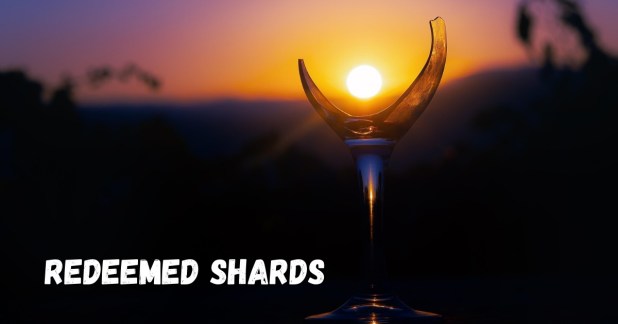
When my theology shattered, I noticed something surprising. The shards reflected more light than the intact window ever had. Because my trust was no longer placed in the coherence of my ideas, but in His faithfulness. The joy of the Lord began to show itself as everyday strength. Not the strength to resolve everything at once, but the strength sufficient for the next step. And then another. And then another.
The Lord is my Shepherd, I shall not be in want. This phrase, so often repeated, is frequently misunderstood. In Hebrew, the expression used is Adonai roi lo echsar. The key word is echsar, from the root chaser, meaning to be lacking, to be deficient, to be without what is essential. It is not a promise of unrestricted abundance or a life without pain. Its meaning is far deeper. I will not be in essential lack. Nothing truly necessary to fulfil the purpose of D us will be denied to me.
This changes everything. During those years, many things were missing. Answers were missing. Healing was missing. Understanding was missing. But the essential was never missing. Presence was not missing. Sustenance was not missing. Grace was not missing. The joy of the Lord as daily strength was not missing. This joy does not eliminate weariness, but it makes it bearable. It does not remove pain, but it prevents it from destroying us.
Today, at fifty five, I recognise that there is powerful testimony in the valley. Not only in achievements, but in days when everything seemed broken. It is there that we learn who D us truly is, not merely who we imagined Him to be. Sometimes He leads us to green pastures. At other times, He walks with us through the valley. At no point does He withdraw.
The true joy of walking with D us is not found in the absence of problems, but in the certainty of His presence. It is not found in never breaking, but in discovering that even shards can be redeemed. D us does not waste pain. He transforms it. He does not promise an easy life, but a meaningful one. And meaning is extraordinarily powerful. It turns weight into depth and suffering into maturity.
If you are walking through your own valley now, know this: you are not alone. It is all right not to be all right. It is all right if your prayer is short. It is all right if some days are filled with laughter and others only with endurance. The joy of the Lord is not fragile. It is firm, resilient and persistent. It refuses to be defeated by circumstances.
Today I celebrate fifty five years with genuine gratitude. Not because everything was easy, but because everything was sustained. Not because I never broke, but because I discovered that even shards can be redeemed. The Shepherd remains present. And that is enough. It has always been enough.
Divine silence is not the end of the story. It is simply the necessary pause before a deeper music.
Adivalter Sfalsin

 Raízes Hebraicas