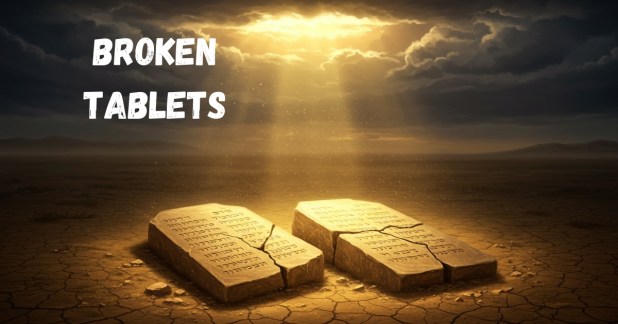
Broken Tablets

Broken Tablets

A Love Deeper than Perfection

Picture yourself, just for a moment, standing atop a mountain. Literally. Imagine the sky stretched in brilliant blue above your head, thunder and lightning still echoing in the distance like the tail-end of a celestial drumroll. And in your hands, two heavy stones. But not just any stones. These were carved by the very finger of G‑d. The living Word etched into cold, lifeless rock. A moment sacred. Weighty. Unrepeatable. Now imagine climbing down from that mountain only to find, not a people waiting in holy awe, but a people dancing around a golden calf, as though they had never left Egypt, at least not in heart. And then, without hesitation, you smash the tablets.

Moses did. And, quite honestly, who could blame him?

The first tablets of the G-d’s instructions, the most precious gift Israel had ever received, were hurled to the ground and shattered at the foot of the mountain. A theatrical gesture? Perhaps. An act of desperation? Certainly. But above all, it was prophetic. Because those broken tablets, as painful as it may be to admit, are also ours. They reflect the human soul: beautifully made, divinely written, and broken.

Here’s something curious. The Bible doesn’t tell us exactly what happened to the broken shards. They might have been swept away with the desert dust, forgotten like discarded sacred clutter. But Jewish tradition preserves something profound. The rabbis teach that the fragments of the first tablets were kept inside the Ark of the Covenant, alongside the whole, restored ones. This tradition is rooted in the words of Deuteronomy. “At that time the Lord said to me, ‘Chisel out two stone tablets like the first ones and come up to Me on the mountain. Also make a wooden ark. I will write on the tablets the words that were on the first tablets, which you broke, and you shall place them (old and new) in the ark.’” (Deuteronomy 10:1–2). And later Moses says, “So I turned and went down the mountain and put the tablets in the ark I had made, as the Lord commanded me, and they are there now.” (Deuteronomy 10:5). This clearly refers to the second set of tablets, but tradition holds that both the whole and the broken were placed together in the holiest place of all. 

Imagine that. Inside the sacred Ark, the very symbol of G‑d’s presence among His people, rested not only what had been restored, but also what had been shattered. It’s as though G‑d Himself were saying, “I do not forget your failures. I redeem even your fragments.” And that’s the heart of it. Faith is not built on a collection of flawless victories, but on a love that refuses to walk away even in the face of the most humiliating defeat. The first covenant was broken. The marriage contract torn apart on the wedding night. Literally. The divine pact was shattered by the hands of a grieved prophet. And yet, or perhaps because of that, G‑d offered a second chance. But the new covenant wasn’t quite like the first. The first tablets were entirely divine. G‑d Himself carved the stone and inscribed the words. The second, however, required more from the human side. Moses chiselled the stone this time, and only then did G‑d rewrite the commandments. A subtle shift, but deeply meaningful. The partnership now demanded more human effort. The relationship had matured.

Have you noticed this in real relationships? The first love is often impulsive, idealistic, even naïve. But the second, after reconciliation, tends to be more thoughtful, more grounded, more enduring. Not because we pretend the pain never happened, but because we face it together. It’s tempting to hide the wreckage of our past. We paper over our inner cracks with religious varnish, clever phrases, or shallow promises. But the broken tablets are there to remind us: you have failed. And more importantly, you were loved nonetheless. G‑d didn’t replace the shattered tablets. He didn’t say, “Throw them away.” He said, “Keep them with Me.” He teaches us that what is broken still has value. That there is beauty in restoration. That there is hope in remembrance.

There is something liberating, almost revolutionary, about admitting your failures before G‑d. Not to wallow in guilt, but to build something new upon truth rather than illusion. We must remember where we came from. We must look back and recognise that we were once idolaters, unfaithful, selfish, ungrateful. We built our own golden calves, fashioned from career, vanity, religion, control, or even our own image of a god made in our likeness. But we also need to look forward. Not with arrogance, but with reverence. Not with an illusion of perfection, but with holy fear. A fear rooted in love. A reverence grounded in grace. A covenant renewed not by merit, but by mercy. We are called to begin again. The broken tablets are a calling. A reminder that G‑d’s presence walks with us not in spite of our failures, but through them. True repentance is not self-hatred. It is a movement toward love. A love that does not deny the truth but transforms it.

What’s broken in your story? Do you, like Moses, need to come down from the mountain, confront your idols, and start again, this time with hands marked by the carving of new tablets? Do you need to stop hiding the shards and place them, with tears and hope, before the Most High? The new covenant was not built on the thrill of the Exodus, but on the grief of the golden calf. Not on spectacular miracles, but on a deeper reverence. A persistent love. A sacred awe.

Perhaps this is what G‑d always wanted. Not perfection, but a relationship born out of sincere repentance. A bond that survives disappointment. A people who walk not just with whole tablets, but with broken ones too. So next time you look back and see only the shattered pieces of your mistakes, remember: they are not the end of the story. They might be the beginning of something new. Don’t hide the fragments. Bring them into the Presence. Place them in the Ark. They belong there. Because the One who wrote the first tablets is the same who writes again on the tablets that we have Chiseled. And He does so with love and waits for us to do the same.

Adivalter Sfalsin

Read also:
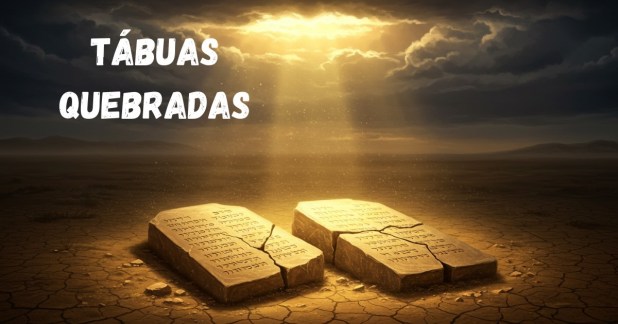
Tábuas Quebradas

Tábuas Quebradas

Um Amor Mais Profundo que a Perfeição

Suponha, por um instante, que você está no topo de uma montanha. Literalmente. Vamos imaginar que você está ali, com o céu estalando azul acima de sua cabeça, trovões e relâmpagos ainda ecoando nas nuvens como ecos de um tambor celestial. E nas mãos, duas pedras pesadas, não qualquer pedra, mas esculpidas pelo dedo de D‑us. A Palavra viva, gravada em pedra. Um momento solene, sagrado. Agora imagine descer daquela montanha e encontrar, não um povo de olhos brilhando de expectativa, mas um povo dançando ao redor de um bezerro dourado, como se tivessem voltado para o Egito não com os pés, mas com o coração. E então, sem hesitar, você quebra as tábuas. Moisés o fez. E, honestamente, quem pode culpá-lo? As primeiras tábuas da Lei, o presente mais precioso que Israel já recebera, foram lançadas ao chão e despedaçadas aos pés da montanha. Um gesto teatral? Talvez. Um ato de desespero? Certamente. Mas acima de tudo, foi um ato profético. Porque aquelas tábuas quebradas, por mais que doa admitir, são também nossas. Elas são um espelho da alma humana: belamente feitas, divinamente escritas, e… partidas.

Agora, aqui está algo curioso. A Bíblia não nos diz explicitamente o que aconteceu com os pedaços quebrados. Poderiam ter sido varridos com o pó do deserto, esquecidos como tralha sagrada. Mas a tradição judaica preserva algo sublime: os rabinos dizem que os pedaços quebrados das primeiras tábuas foram guardados na Arca da Aliança, ao lado das tábuas novas. Baseiam-se principalmente nos seguintes textos: “Naquela ocasião o Senhor me disse: ‘Lave duas tábuas de pedra como as primeiras, e suba ao monte para encontrar-me. Faça também uma arca de madeira. Eu escreverei nas tábuas as palavras que estavam nas primeiras, que você quebrou, e você as (ambas) colocará dentro da arca’” (Deuteronômio 10:1–2)

E então Moisés diz: “Então virei e desci do monte e coloquei as tábuas na arca que havia feito, conforme o Senhor me ordenara, e ali estão até hoje.” (Deuteronômio 10:5) Aqui se refere ao segundo conjunto de tábuas, mas a tradição preserva a ideia de que ambas, as inteiras e as quebradas, estavam ali dentro.

Imagine isso. Dentro da Arca sagrada, símbolo máximo da presença de D‑us entre os homens, repousam não só o que foi restaurado, mas também o que foi despedaçado. É como se o próprio D‑us dissesse: “Eu não me esqueço das falhas. Eu redimo até os cacos.” E aqui está a chave. A fé não é construída sobre uma coleção de vitórias impecáveis, mas sobre um amor que se recusa a desistir mesmo diante dos fracassos mais humilhantes. A primeira aliança foi quebrada, o contrato de casamento rasgado na primeira noite. Literalmente. A aliança divina foi quebrada pelas mãos de um profeta indignado. E mesmo assim, ou talvez por causa disso, D‑us oferece uma segunda chance. Mas essa nova aliança não é como a primeira. As primeiras tábuas foram obra 100% divina, D‑us mesmo esculpiu e escreveu. Já as segundas, veja bem, foram esculpidas por Moisés, e apenas as palavras foram reescritas por D‑us. Um gesto sutil, mas significativo. Agora, a parceria requer mais esforço humano. A fé amadurece.

Você já percebeu isso nos relacionamentos? O primeiro amor pode ser impulsivo, idealista, ingênuo até. Mas o segundo, quando há reconciliação, costuma ser mais maduro, mais consciente, mais profundo. Não porque ignoramos os erros, mas porque os encaramos juntos. É muito tentador tentar esconder os destroços do passado. Tapamos os buracos da alma com verniz religioso, frases de efeito, promessas vazias. Mas as tábuas quebradas estão ali para nos lembrar: você já falhou. E, mais importante ainda, você foi amado mesmo assim. Aliás, D‑us não substitui as tábuas quebradas. Ele não diz “jogue fora isso”. Ele diz: “Guarde-as comigo”. Ele nos ensina que o quebrado tem valor. Que há beleza na restauração. Que há esperança no reconhecimento.

Há algo de extraordinariamente libertador em admitir nossas falhas diante de D‑us. Não para nos martirizarmos, mas para construir algo novo sobre a verdade, não sobre a ilusão. A memória dos cacos Porque precisamos nos lembrar de onde viemos. Precisamos olhar para trás e reconhecer que fomos idólatras, infiéis, egoístas, ingratos. Que fizemos nossos próprios bezerros dourados, feitos de carreira, vaidade, religião, controle, ou mesmo da imagem de um deus criado à nossa própria semelhança. Mas precisamos, também, olhar para frente. Não com arrogância, mas com reverência. Não com a ilusão de perfeição, mas com o temor santo de quem sabe que foi resgatado. Que o pacto não foi renovado por merecimento, mas por misericórdia. Somos chamado para recomeçar. As tábuas quebradas são um chamado. Um lembrete de que a presença de D‑us caminha conosco, não apesar dos nossos fracassos, mas através deles. O arrependimento verdadeiro não é um estado de auto-aversão, mas um movimento em direção ao amor. Um amor que não ignora a verdade, mas a redime.

Será que você precisa, como Moisés, descer da montanha, enfrentar os ídolos, e começar tudo de novo, desta vez com as mãos calejadas pela escultura das novas tábuas? Será que você precisa parar de esconder os cacos e colocá-los, com lágrimas e esperança, diante do Altíssimo? Amor, temor e reverência. A nova aliança não foi construída sobre o entusiasmo do êxodo, mas sobre o luto do bezerro de ouro. Não sobre milagres espetaculares, mas sobre um novo temor, uma reverência profunda, e um amor persistente. Talvez seja isso que D‑us sempre quis: não perfeição, mas uma aliança que nasce do arrependimento sincero. Uma relação que sobrevive às decepções. Um povo que caminha com as tábuas inteiras… e também com as quebradas.

Então, da próxima vez que você olhar para trás e enxergar só os estilhaços dos seus erros, lembre-se: eles não são o fim da história. Eles podem ser o começo de algo novo. Não esconda os cacos. Leve-os até a Presença Divina. Coloque-os na Arca. Eles pertencem lá. Pois aquele que nos deu as primeiras tábuas é o mesmo que escreve novamente, nas tábuas que nós esculpimos. E o faz com amor e espera que nós façamos o mesmo.

Adivalter Sfalsin

Leia também:

Siga nosso canal de estudos bíblicos no WhatsApp e mergulhe conosco nas verdades eternas das Escrituras.

🌿 Reflexões diárias. 🌍 Temas profundos. 💡 Espiritualidade prática.

👉 Clique aqui para entrar: