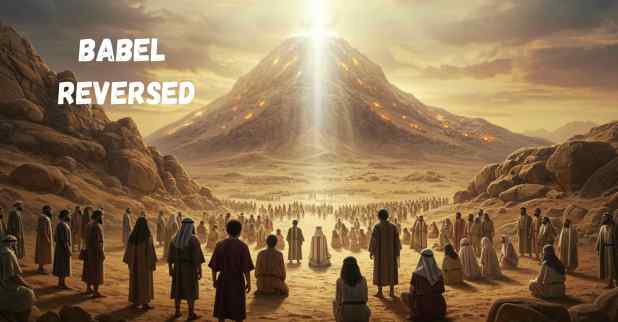
Babel reversed

Babel reversed

From Babel to Sinai to Jerusalem

There are moments in history that, if you squint just right and tilt your head in the direction of Heaven, you can almost see the grand Author’s hand turning a page. Babel, Sinai, and Jerusalem these are not merely locations upon a map, but punctuation marks in a divine narrative. We find ourselves, dear reader, caught in the middle of this tale.

Let us begin, as every good story does, at the beginning or nearly so.

At Babel, man conspired to construct a staircase to the stars. It was, I daresay, our first global committee. In Genesis 11:4, the ambitious proclamation is recorded:  “Come, let us build ourselves a city and a tower with its top in the heavens, and let us make a name for ourselves.”  Alas, pride is a poor architect. Instead of Heaven, they built confusion. Instead of glory, they earned scattering.  “Therefore the name of it was called Babel, because there the Lord confused the language of all the earth.”  (Genesis 11:9)

One cannot help but feel the sadness of it all. There is something inherently good about togetherness, about harmony. But at Babel, we grasped at divinity not to know G-d, but to replace Him. A unity bent inward collapses upon itself. And so the world fractured, not with war, but with syllables.

Yet G-d does not abandon. Like a master teacher who allows the child to stumble so they may learn to walk, He lets the dust settle, then begins again. Enter Abraham, a single man in a confused world, called out in Genesis 12:1–3 to be the seed of a new blessing:  “In you all the families of the earth shall be blessed.” 

Now, fast-forward a few centuries some six or nine, depending on whose sandglass you prefer and we arrive at Sinai. The smoke and thunder of Exodus 19 do not signify judgment alone, but intimacy. Heaven does not require towers; it descends by choice.  “And the Lord came down upon Mount Sinai.”  (Exodus 19:20) This is no god of marble statues or mute idols. This is a G-d who speaks.

Indeed, He speaks with such clarity that tradition says each word split into seventy tongues, the languages of all known nations. The same Voice that once divided now divides again not to confuse, but to reveal.  “And G-d spoke all these words…”  (Exodus 20:1) And later:  “You heard the sound of words, but saw no form; there was only a voice.”  (Deuteronomy 4:12) Here, the cacophony of Babel finds its counterpoint not in silence, but in singularity.

Israel, freshly redeemed from Egypt, is offered a vocation:  “You shall be to Me a kingdom of priests and a holy nation.”  (Exodus 19:6) They are chosen, yes, but not for themselves. A priest does not hoard light; he reflects it. Like Abraham before them, Israel was to be the conduit of divine blessing, not its reservoir.

Ah, but the story does not end in thunder and tablets.

Spin the globe and the clock forward again some 1,300 years or more and find yourself in Jerusalem. The air is thick with anticipation; the streets hum with pilgrims. It is Shavuot, the Feast of Weeks, and once again G-d chooses to speak.

 “And suddenly there came from heaven a sound like a mighty rushing wind… and divided tongues as of fire appeared to them and rested on each one of them.”  (Acts 2:2–3) It is Sinai again, but not quite. Fire falls not upon a mountain, but upon men. The words do not thunder from above, but pour forth from within.

And what words they are!

 “We hear them telling in our own tongues the mighty works of G-d.”  (Acts 2:11) Jews from all parts of the roman empire were present for the festival of shakeout, jews from Parthians, Medes, Elamites so many names, each representing a Babel once broken. The miracle of Pentecost is not the spectacle, but the synthesis. The Spirit does not erase distinction; He sanctifies it. A return to unity, not uniformity.

Peter, with the boldness of one freshly breathed upon, explains:  “In the last days, G-d declares, I will pour out my Spirit on all flesh…”  (Acts 2:17, quoting Joel 2:28)

And so, dear reader, we are left with three scenes:

At Babel, man ascends in arrogance and is scattered.

At Sinai, G-d descends in fire and calls a nation.

At Jerusalem, the fire descends again, now it spreads to corners of the known world.

What, then, shall we make of all this?

Firstly, let us learn that unity is not achieved by building towers, but by receiving truth. The Gospel speaks every tongue not by flattening them into one, but by filling each with the fragrance of Heaven. At Babel, our languages divided. At Pentecost, they became instruments of praise.

Secondly, chosenness is not a trophy. It is a task. Israel was chosen not to be better, but to bless. As Isaiah 49:6 reminds us:  “I will make you as a light for the nations, that My salvation may reach to the end of the earth.”  We the gentiles, too, shares this priestly calling: to reconcile, to bless, to serve.

Thirdly and perhaps most importantly we are caught between Pentecost and Parousia, the time between the fire and the final glory.  “All this is from G-d, who through Christ reconciled us to Himself and gave us the ministry of reconciliation.”  (2 Corinthians 5:18) Babel still echoes in our politics, our pride, our pulpits. But Sinai still calls. And Jerusalem still burns.

Do you long for the end of the story? I do. So did John. And he saw it:

 “After this I looked, and behold, a great multitude that no one could number, from every nation, from all tribes and peoples and languages, standing before the throne…”  (Revelation 7:9) The languages are still there, you notice. G-d does not undo Babel by reverting to sameness. He redeems it through harmony. And in that place, in the city not built with hands, there will be no need to make a name for ourselves.  “To the one who conquers… I will give a white stone, with a new name written on it.”  (Revelation 2:17) Not the name we tried to make. The one He always knew.

So here we are. The page has not yet turned. But the pen is in the Author’s hand. We are not spectators. We are characters. Better yet we are sons and daughters.

When the world divides, let us reconcile.

When it builds new Babels, let us remember the fire.

When it forgets the Voice, let us echo it.

For the Spirit did not come to make us loud. He came to make us clear.

Clarity in truth. Clarity in love. Clarity in mission.

Take heart, dear reader. The towers of man will fall, but the mountain of the Lord shall rise. And all nations shall flow to it. (Isaiah 2:2)

Adivalter Sfalsin

Read also:
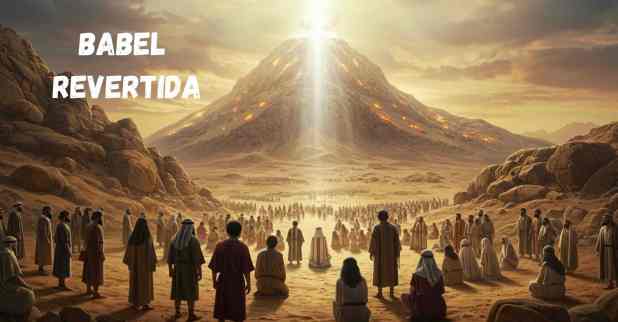
Babel revertida

Babel Revertida

De Babel ao Sinai e a Jerusalém

Há momentos na história em que, se você fixar os olhos na direção do Céu, pode quase ver a mão do grande Autor virando uma página. Babel, Sinai e Jerusalém não são meramente pontos em um mapa, mas sinais de pontuação em uma narrativa divina. Nós nos encontramos, caro leitor, bem no meio desse conto.

Comecemos, como toda boa história começa, no início  ou quase.

Em Babel, o homem conspirou para construir uma escada até as estrelas. Foi, ouso dizer, nosso primeiro comitê global. Em Gênesis 11:4, o plano ambicioso está registrado: 

“Vamos construir uma cidade com uma torre que alcance os céus. Assim nosso nome será famoso.” Infelizmente, o orgulho é um péssimo arquiteto. Em vez do Céu, construímos confusão. Em vez de glória, ganhamos dispersão. “Por isso foi chamada Babel, porque ali o Senhor confundiu a linguagem de toda a terra.” (Gênesis 11:9)

É impossível não sentir certa tristeza nisso tudo. Há algo de inerentemente bom na união, na harmonia. Mas em Babel, buscamos a divindade não para conhecer a D-us, mas para substituí-lo, fazer um nome para nós mesmos. Uma unidade voltada para si mesma desaba. E assim, o mundo se fragmentou  não com guerras, mas com sílabas.

Mas D-us não abandona. Como um mestre que permite que a criança tropece para que aprenda a andar, Ele deixa a poeira baixar, e então começa de novo. Surge Abraão, um único homem em um mundo confuso, chamado em Gênesis 12:1–3 para ser a semente de uma nova bênção: “Por meio de você, todas as famílias da terra serão abençoadas.”

Avançando alguns séculos  seis ou nove, dependendo da sua ampulheta  chegamos ao Sinai. A fumaça e o trovão de Êxodo 19 não significam apenas julgamento, mas intimidade. O Céu não precisa de torres; Ele desce por escolha. “O Senhor desceu sobre o monte Sinai.” (Êxodo 19:20) Esse não é um deus de estátuas de mármore ou ídolos mudos. Esse é um D-us que fala.

E fala com tanta clareza que a tradição judaica diz que cada palavra se dividiu em setenta línguas, representando todas as nações conhecidas. A mesma Voz que antes dividiu, agora divide de novo  não para confundir, mas para revelar. “Então falou D-us todas estas palavras…” (Êxodo 20:1). E depois: “Vocês ouviram o som das palavras, mas não viram figura alguma; apenas uma voz.” (Deuteronômio 4:12) Aqui, a cacofonia de Babel encontra seu contraponto  não no silêncio, mas na singularidade.

Israel, recém-liberto do Egito, recebe uma vocação: “Vocês serão para mim um reino de sacerdotes e uma nação santa.” (Êxodo 19:6) Foram escolhidos, sim, mas não para si mesmos. Um sacerdote não guarda a luz  ele a reflete. Como Abraão antes deles, Israel foi chamado para ser canal de bênção divina, não seu reservatório.

Ah, mas a história não termina com trovões e tábuas.

Gire o globo e avance no tempo mais 1.300 anos ou mais, e nos encontramos em Jerusalém. O ar está carregado de expectativa; as ruas fervilham de peregrinos. É Shavuot, a Festa das Semanas, e mais uma vez D-us decide falar a esse mesmo povo.

“De repente veio do céu um som, como de um vento muito forte… e línguas como de fogo pousaram sobre cada um deles.” (Atos 2:2–3) É o Sinai novamente  mas não exatamente. O fogo não cai sobre um monte, mas sobre homens. As palavras não trovejam do alto, mas jorram de dentro de cada um.

E que palavras!

“Os ouvimos declarar as maravilhas de D-us em nossa própria língua!” (Atos 2:11) Judeus de todas as partes do império romano estavam presentes para a festa  partos, medos, elamitas… tantos nomes, cada um representando um antigo Babel. O milagre de Pentecostes não está no espetáculo, mas na síntese. O Espírito não apaga as distinções  Ele as santifica. Um retorno à unidade, não à uniformidade.

Pedro, com a ousadia de quem acaba de ser soprado pelo Espírito, explica: “Nos últimos dias, diz D-us, derramarei do meu Espírito sobre toda a humanidade…” (Atos 2:17, citando Joel 2:28)

E assim, caro leitor, ficamos com três cenas:

Em Babel, o homem sobe em arrogância e é espalhado.

No Sinai, D-us desce em fogo e chama uma nação.

Em Jerusalém, o fogo desce novamente, Ele se espalha pelos cantos do mundo conhecido.

O que devemos fazer com tudo isso?

Primeiramente, aprendamos que a unidade não é alcançada erguendo torres, mas recebendo a verdade. O Evangelho fala todas as línguas  não as achatando em uma só, mas enchendo cada uma com a fragrância do Céu. Em Babel, nossas línguas nos dividiram. Em Pentecostes, tornaram-se instrumentos de louvor.

Segundo, ser escolhido não é troféu  é tarefa. Israel foi escolhido não para ser melhor, mas para abençoar. Como nos lembra Isaías 49:6: “Eu farei de vos luz para os gentios, para que levem a minha salvação até os confins da terra.” Nós, gentios enxertados, também partilhamos dessa vocação sacerdotal: reconciliar, abençoar, servir.

E por fim, talvez o mais importante  estamos entre Shavout – Pentecostes e a Parúsia, entre o fogo e a glória final. “Tudo isso provém de D-us, que nos reconciliou consigo mesmo por meio de Cristo e nos deu o ministério da reconciliação.” (2 Coríntios 5:18) Babel ainda ecoa em nossa política, nosso orgulho, nossos púlpitos. Mas o Sinai ainda chama. E Jerusalém ainda proclama as boas novas.

Você anseia pelo fim dessa história? Eu anseio. João também. E ele viu:

“Depois disso olhei, e diante de mim estava uma grande multidão que ninguém podia contar, de todas as nações, tribos, povos e línguas, em pé diante do trono…” (Apocalipse 7:9) 

As línguas ainda estão lá, percebe? D-us não desfaz Babel revertendo à mesmice. Ele a redime pela harmonia. E nesse lugar, na cidade não construída por mãos humanas, não haverá mais a necessidade de fazer um nome para nós. 

“Ao que vencer… darei uma pedra branca, com um novo nome nela escrito.” (Apocalipse 2:17) Não o nome que tentamos construir. O nome que Ele sempre conheceu.

Então aqui estamos. A página ainda não virou. Mas a caneta está na mão do Autor. Não somos espectadores. Somos personagens. Melhor ainda  somos filhos e filhas.

Quando o mundo divide, reconciliemos.

Quando constrói novos Babels, lembremos do fogo.

Quando esquece a Voz, sejamos seu eco.

Pois o Espírito não veio para nos tornar barulhentos. Ele veio para nos tornar claros.

Clareza na verdade. Clareza no amor. Clareza na missão.

Ânimo, caro leitor. As torres dos homens cairão, mas o monte do Senhor se elevará. E todas as nações fluirão para ele. (Isaías 2:2)

Adivalter Sfalsin

Leia também: